
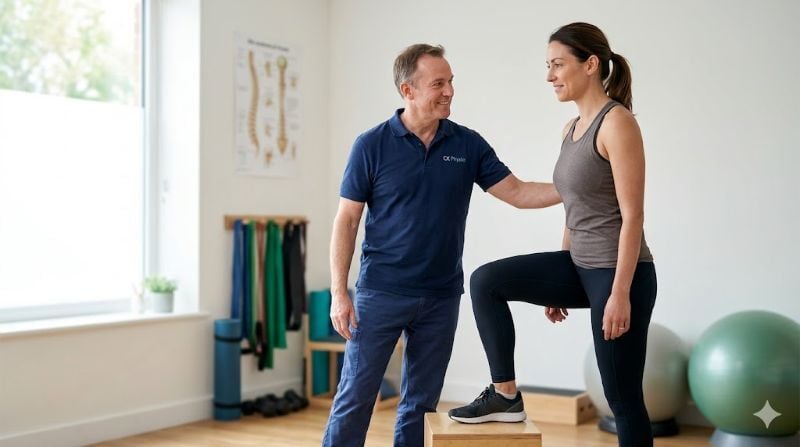

The safest way to start a fitness routine is to build gradually, set SMART goals, and address any existing pain or movement limits before you begin. Most new-exerciser injuries — muscle strains, shin splints, tendonitis — come from doing too much, too soon. A short physiotherapy assessment identifies your starting point and helps you build a routine that lasts well beyond January.
Key Takeaway
Two-thirds of new fitness routines collapse within three months — almost always for the same handful of reasons. The fix is rarely more willpower. It is a realistic plan, an honest baseline, the 10% progression rule, and, where the body is already telling you something, a Chartered Physiotherapist involved at the start rather than after the injury.
The 2026 reality: why most new fitness routines stall
January brings one of the largest annual surges in physical activity intent across the UK. A YouGov poll published in December 2025 found that 23% of Britons making New Year's resolutions for 2026 named getting fit as their top goal — the most popular resolution overall. Yet behavioural research consistently finds that around 43% of people abandon their fitness resolution within a single month, and only about one in ten expect theirs to last beyond three months.
The causes are familiar: unrealistic targets, no built-in accountability, and — for too many — a niggle or flare-up in the first few weeks that derails the whole effort. According to Sport England's most recent Active Lives Adult Survey for 2024–25, around a quarter of adults in England still do not move enough to benefit their long-term health. Encouragingly, work by the Office for Health Improvement and Disparities finds that a meaningful share of UK adults say they would be more active if a healthcare professional advised them how.
That is where a Chartered Physiotherapist earns their keep. A short pre-exercise consultation identifies the weaknesses, movement limits and old niggles that quietly turn enthusiasm into injury — and replaces them with a clear plan built around your body, not someone else's training programme.
The five most common injuries in new exercisers
Most injuries in people starting a new fitness routine fall into one of five categories. Each has a clear cause, a typical recovery window, and a point at which professional input shortens that window significantly.
Muscle strains
Usually in the hamstrings, calves or lower back, caused by sudden loading without an adequate warm-up.
Shin splints
Pain along the front of the shin, common in new runners. Driven by abrupt increases in running volume on hard surfaces.
Tendonitis
Most often in the Achilles, patellar (knee) or elbow tendons. The product of repetitive load without adequate recovery between sessions.
Joint pain
Typically knees, shoulders and hips. A signal that the strength or mobility around a joint has not yet caught up with the demand being placed on it.
Lower back pain
Often from poor lifting technique, weak core stability, or sudden axial loading early in a routine.
If pain persists beyond 48 hours, worsens with activity, or stops you sleeping, that is the signal to book a physiotherapy assessment rather than wait it out. Early intervention typically resolves these issues in two to four sessions; left untreated, many become chronic and a great deal harder to clear.
Five mistakes that cause new-exerciser injuries
Most preventable injuries trace back to a small number of decisions made in the first two weeks of a new routine. Each is easy to avoid once you know what to watch for.
- Doing too much, too soon. A widely accepted training principle is to increase volume by no more than around 10% per week. Connective tissue adapts more slowly than muscle, and rushing it is the single most common cause of injury we see.
- Skipping the warm-up. Five to ten minutes of dynamic movement raises tissue temperature, prepares the joints, and meaningfully reduces strain risk. It is not optional.
- Ignoring early warning signs. A niggle you push through often becomes a six-week problem. Persistent discomfort is information, not weakness.
- Poor technique under load. Most strength-training injuries come from form breakdown, not from weight that is too heavy. Quality of movement first, then progression.
- No recovery days. Tissue adaptation happens during rest, not during the session itself. Two to three rest days a week is not a compromise — it is part of the plan.
At CK Physio, our holistic approach treats every new exerciser as an individual. We assess movement patterns, posture and injury history before recommending how you should progress — so your routine builds you up rather than wears you down.
Not sure where your body is starting from?
A 45-minute assessment with a Chartered Physiotherapist gives you a clear movement baseline, an honest answer on any niggles, and a plan written around your goals.
Book a Pre-Exercise Assessment →How to set SMART fitness goals that actually stick
Goal-setting separates the small proportion of people who reach March from the much larger group who quit by February. The SMART framework — Specific, Measurable, Achievable, Relevant, Time-bound — works because it converts a vague intention into something you can actually do tomorrow.
Specific
Replace "get fit" with something concrete. "Run a parkrun 5K in 12 weeks" or "walk 8,000 steps a day, five days a week" are specific. Your body responds to clear signals, not vague hopes.
Tip: Write your goal in a single sentence. If you cannot, it is not specific enough yet.
Measurable
Track progress with whatever tool you will actually use — a smartphone health app, a fitness watch, parkrun results, or simply a wall calendar with ticks. Research published by London Sport in early 2026 found that 42% of people who sign up to a structured fitness event (a 5K, 10K or charity challenge) stuck with their resolution beyond January, compared to around 10% of those who did not.
Tip: Choose one primary metric — steps, distance, sessions per week — and do not let yourself drown in data.
Achievable
Be honest about your starting point. If you have not exercised in three years, week one is not the time for high-intensity training. Build a base for two to three weeks before introducing more demanding sessions.
Tip: A useful sanity check — could you comfortably repeat tomorrow what you did today? If the honest answer is no, today was too much.
Relevant
Connect your goal to what genuinely matters to you. The 2026 PureGym UK Fitness Report found 32% of UK adults want to improve their energy levels and 29% want to improve their mental health — outcomes that come from consistent moderate activity, not punishing routines. The British Heart Foundation's April 2026 survey found that 70% of people would be more motivated to stick with exercise if they focused on enjoying it rather than how it makes them look.
Tip: Frame your "why" in your own words: more energy at work, playing with the kids without getting out of breath, sleeping better, or simply moving without pain.
Time-bound
Choose a 12-week horizon for your first phase. It is long enough to see real change, short enough to feel urgent. Review at week six and adjust honestly.
Tip: Put the review date in your calendar now. Goals without deadlines slide.
When to see a physiotherapist before you start exercising
A pre-exercise physiotherapy consultation is not only for people with existing injuries. It is a baseline assessment — a way of starting your routine with a clear picture of where your body is today, and a plan built around it rather than guesswork.
Consider booking an assessment if you:
- Are returning to exercise after a break of 12 months or more
- Are over 50 and beginning a new type of training
- Have an existing or recurring injury, however minor it feels
- Live with chronic back, neck, knee or shoulder pain
- Have had surgery within the past 12 months
- Are in the first year postnatal and want to rebuild safely
- Are training toward a specific event with a fixed deadline
- Felt unusual pain or weakness during your first few sessions
CK Physio's Chartered Physiotherapists offer in-clinic appointments in Hanwell and home visits across West London. A first assessment typically takes 45–60 minutes and produces a tailored plan you can take into the gym, onto the road, or back to your living-room mat.
A simple six-week structure to build sustainable fitness
This is not a prescription — your plan should be built around your body, your goals, and any conditions you live with. But for most healthy adults starting from a low base, a progression along these lines protects against injury while building genuine fitness. If you have any concerns about whether this structure is right for you, talk to a Chartered Physiotherapist or your GP before you start.
The NHS and UK Chief Medical Officers' physical activity guidelines recommend at least 150 minutes of moderate-intensity activity (or 75 minutes of vigorous activity) per week, plus two strengthening sessions. That is the destination — not week one. Build towards it.
Want a deeper dive on specific starter exercises? Read our Chartered Physiotherapist's strengthening exercise guide and our advice on gentle stretching routines for walking and strolling. For lower-impact alternatives — particularly if you are managing joint pain — see how aquatherapy and swimming can complement a beginner routine.
Frequently asked questions
How long does it take to see results from a new fitness routine?
Most people notice improved energy and sleep within two to three weeks of consistent moderate exercise. Measurable changes in strength and cardiovascular fitness typically appear at six to eight weeks. Changes in body composition usually take 12 weeks or more, depending on consistency, nutrition and your starting point.
Do I need to see a physiotherapist before starting exercise?
No — healthy adults without pain or recent injury can start a moderate routine safely. A physiotherapy assessment is recommended if you have existing pain, are returning after a long break, are over 50, are in the first year postnatal, have had surgery in the past 12 months, or are training for a specific event.
How much exercise should a beginner do each week?
UK Chief Medical Officers' guidelines recommend 150 minutes of moderate activity, such as brisk walking, plus two strengthening sessions weekly. Beginners should build towards this gradually — starting at 60–90 minutes a week and adding around 10% volume each week to avoid overload injuries.
What should I do if I get injured starting a new fitness routine?
Stop the activity that caused the pain, manage swelling with rest and gentle compression, and avoid pushing through sharp or worsening pain. If pain persists beyond 48 hours, worsens with movement, or stops you sleeping, book a physiotherapy assessment. Early professional input usually shortens recovery significantly.
Can I exercise if I have existing back pain?
In most cases of non-specific lower back pain, yes — current Chartered Society of Physiotherapy guidance encourages safe, graded movement rather than prolonged rest. The type of exercise matters, however. A Chartered Physiotherapist can identify which movements help and which to avoid in your specific case, and build a plan that strengthens rather than aggravates.
Ready to start your 2026 routine the right way?
You do not have to wait for an injury before seeing a physiotherapist. A short assessment at the start of a new fitness routine is one of the most valuable hours you can invest in your year. We listen to your goals, look at how you move, identify the issues most likely to derail you — and give you a plan built around your body.
Book your assessment →CK Physiotherapy is a physiotherapy clinic in Hanwell, West London, staffed by Chartered Physiotherapists and serving Ealing and the surrounding boroughs since 2003. In-clinic appointments, home visits and virtual consultations available.
References & further reading
- UK Department of Health and Social Care & the four UK Chief Medical Officers. Physical Activity Guidelines: UK Chief Medical Officers' Report. gov.uk — UK CMOs' Physical Activity Guidelines
- NHS. Physical activity guidelines for adults aged 19 to 64. nhs.uk/live-well/exercise
- Sport England. Active Lives Adult Survey, November 2024–25. sportengland.org — England is getting more active
- Office for Health Improvement and Disparities (OHID). Physical activity: applying All Our Health. gov.uk — OHID Physical Activity Guidance
- Chartered Society of Physiotherapy. How to get more active. csp.org.uk — Keeping active and healthy
- Health and Care Professions Council. Check the Register. hcpc-uk.org/check-the-register
Medical disclaimer: This article is for general information only and does not replace personalised clinical advice. If you have a specific concern about pain, an injury, or your suitability for exercise, please speak to a Chartered Physiotherapist or your GP. CK Physiotherapy clinicians are registered with the Health and Care Professions Council (HCPC) and are members of the Chartered Society of Physiotherapy (MCSP).
Bryan Kelly
Chartered Physiotherapist (MCSP, HCPC-registered), CK Physiotherapy, Hanwell
Bryan graduated in physiotherapy from Curtin University, Perth, in 1995 and has been practising in West London since 1997. He founded CK Physiotherapy in Hanwell in 2003. His clinical interests include musculoskeletal rehabilitation, sports injuries, spinal conditions and postural assessment, integrating manual therapy, exercise programmes and evidence-based home-care guidance into every treatment plan.




.svg)

.svg)

.svg)