


Healthy Ageing & Mobility
Published 3 December 2018 · Last updated 23 June 2026 · Medically reviewed by the CK Physio Clinical Team, Chartered Physiotherapists · 8 min read
Physiotherapy for healthy ageing helps older adults stay strong, steady and independent by building muscle strength, balance and confidence — ideally before pain, stiffness or a fall makes everyday life harder. At CK Physio, our Chartered Physiotherapists have helped people across Hanwell, Ealing and West London move well and feel well since 2003, with appointments at our clinic or through home visits that remove the stress of travel.
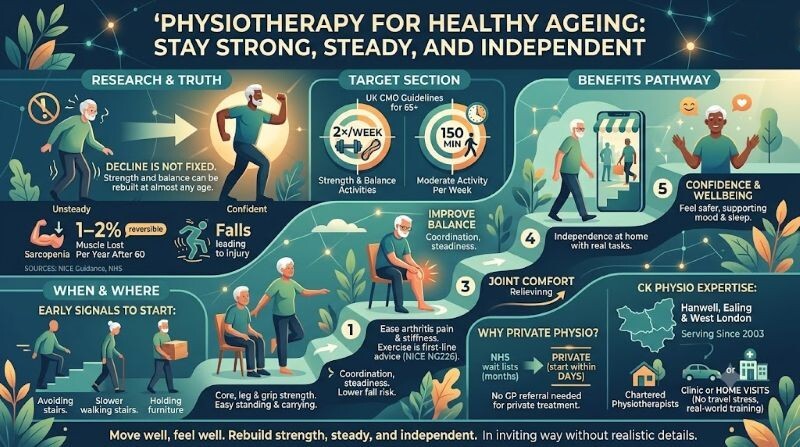
Physiotherapy for Healthy Ageing: How to Stay Strong, Steady and Independent
Here is the encouraging part, supported by decades of research: much of what we tend to accept as "just getting older" — weakness, unsteadiness, a loss of confidence — is not fixed. With the right, personalised programme, strength and balance can be rebuilt at almost any age. Ageing well is a journey, and you have more say over it than you might think.
Key Takeaway
Staying active is the single most protective thing most older adults can do for their independence. UK guidelines recommend strength and balance activities on at least two days a week for the over-65s, and physiotherapy is the most personalised way to build them safely. Starting before a fall or flare-up — not after — gives you the greatest benefit.
1–2%
Muscle lost per year
After 60 — but largely reversible with training
2×/week
Strength & balance
UK Chief Medical Officers' guideline, 65+
150 min
Activity per week
Moderate activity recommended for older adults
22+ yrs
CK Physio experience
Serving Hanwell, Ealing & West London
Sources: UK Chief Medical Officers' Physical Activity Guidelines, NHS Physical Activity Guidelines for Older Adults
Why does staying active matter more as you age?
Staying active matters more with age because the body gradually loses strength and balance unless we work to maintain them. From around the age of 60, adults lose roughly 1–2% of muscle mass each year — a natural process called sarcopenia — which slowly makes everyday tasks such as climbing stairs, carrying shopping or rising from a chair feel harder. Balance and coordination also decline, which is why a momentary wobble can turn into a fall.
The good news is that this decline is not a one-way street. Muscle and balance respond to training at any age, including in people in their 80s and 90s. That is why the UK Chief Medical Officers recommend that adults aged 65 and over do activities to improve strength, balance and flexibility on at least two days a week, alongside 150 minutes of moderate activity. A CK Physio programme is simply the most personalised, safe way to meet those targets when general gym classes feel too fast, too generic or too daunting.
What are the benefits of physiotherapy for older adults?
The benefits of physiotherapy for older adults reach well beyond recovering from injury. A Chartered Physiotherapist assesses how you move, then designs a gentle, progressive plan to keep you strong, comfortable and confident in daily life. The benefits CK Physio's patients across West London most often notice are these:
| Benefit | How physiotherapy helps |
|---|---|
| Strength | Progressive exercises rebuild leg, core and grip strength for stairs, standing and carrying. |
| Balance & steadiness | Targeted balance work improves coordination and lowers the risk of trips and falls. |
| Joint comfort | Movement and gentle manual therapy ease arthritic joint pain and stiffness — exercise is NICE's first-line advice for osteoarthritis. |
| Everyday mobility | Practising real tasks — sit-to-stand, walking, turning — keeps you independent at home. |
| Confidence & wellbeing | Feeling steadier supports mood, sleep and the confidence to stay socially active. |
Source: NICE Guideline NG226 — Osteoarthritis: diagnosis and management
If you are caring for an elderly parent and want the fuller clinical picture — including the conditions physiotherapy supports and what an assessment involves — our complete guide to physiotherapy for the elderly covers it in depth.
How does physiotherapy help you stay independent at home?
Physiotherapy helps you stay independent at home by training the specific movements daily life depends on, rather than abstract exercises. A Chartered Physiotherapist looks at the tasks that matter to you — getting out of bed or a low chair, managing the stairs, stepping into the shower, walking to the shops — and builds the strength, balance and technique to do them safely and confidently.
For many older adults in Hanwell and Ealing, the most practical option is to be seen at home. CK Physio's home visit physiotherapy means no stressful travel, no waiting rooms, and a programme tailored to your actual environment — your stairs, your kitchen, your bathroom. That real-world relevance is one reason people find it easier to keep a home-based plan going.
Prefer to be seen at home? Our home visit physiotherapy brings expert care to your door across West London.
Explore Home VisitsCan physiotherapy reduce the risk of falls?
Yes — physiotherapy can reduce the risk of falls in older adults, and it is one of the most effective tools available. Falls are the leading cause of injury-related hospital admission in the over-65s, and most are linked to factors we can change: muscle weakness and impaired balance. NICE guidance recommends structured strength and balance training as a first-line way to lower fall risk, and well-designed programmes have been shown to meaningfully reduce falls among people who take part.
Because falls prevention is such an important subject, CK Physio covers the full picture — including the evidence-based Otago programme and how a falls-risk assessment works — in our dedicated guide to elderly physiotherapy, mobility and falls prevention. If your parent has recently had a fall or a near-miss, that is the best place to start, or you can simply contact our team for friendly advice.
When should an older adult see a physiotherapist?
The best time to see a physiotherapist is before a problem becomes serious — you do not need to wait for a fall or a diagnosis. It is worth booking an assessment if you, or a parent, have started avoiding the stairs, holding onto furniture while walking, feeling slower or less steady, struggling to rise from a chair, or losing the confidence to go out. These are early signals that strength and balance deserve attention.
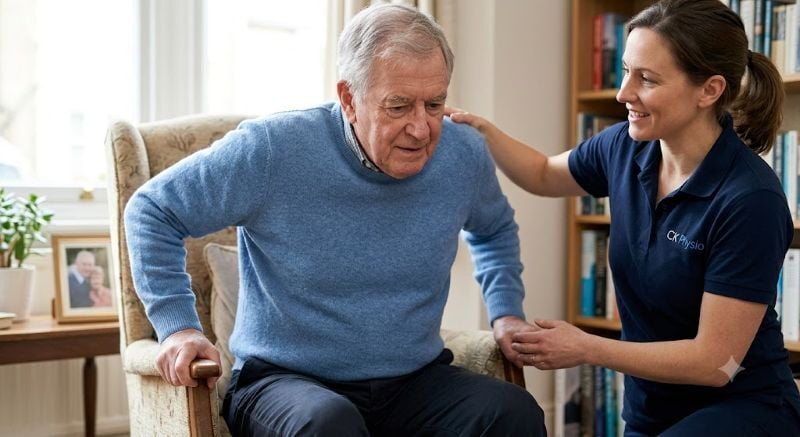 Timing matters for a practical reason too. NHS community physiotherapy is excellent but in high demand: a Healthwatch England review in early 2026 found many people waiting months for an appointment. For families who want to act quickly — particularly after a hospital discharge with "physiotherapy recommended" — private care offers a faster start. CK Physio complements NHS care, and we are glad to work alongside your GP and any existing care team. If recovery from a specific illness or operation is the priority, our guide to ageing rehabilitation and physiotherapy explains what to expect.
What does a physiotherapy session for older adults involve?
A physiotherapy session for older adults begins with a friendly, unhurried assessment of how you move, your strength and balance, and the goals that matter to you — whether that is gardening, playing with grandchildren, or simply feeling safe on the stairs. From there, your Chartered Physiotherapist builds a personalised, non-invasive plan using gentle hands-on techniques and a manageable home exercise programme.
Sessions can take place at our Hanwell clinic or in your own home, whichever is more comfortable and practical. There is no pressure and no one-size-fits-all routine: the plan is paced to you and adjusted as you progress. You can read more about our physiotherapy approach, or see current fees and book on our bookings page.
Frequently asked questions
Is it ever too late to start physiotherapy as you get older?
No — it is rarely too late to benefit. Research consistently shows that older adults, including those in their 80s and 90s, can build meaningful strength and balance through progressive exercise. A Chartered Physiotherapist tailors the starting point and pace to your current ability, so improvement stays realistic and safe at any age.
How often should an older adult exercise to stay strong?
UK guidelines recommend that adults aged 65 and over do strength and balance activities on at least two days a week, plus around 150 minutes of moderate activity. A physiotherapist can translate those targets into a simple, personalised routine that fits your health, your home and your confidence level.
Can physiotherapy be done at home for elderly parents?
Yes. CK Physio offers home visit physiotherapy across Hanwell, Ealing and West London, which is ideal for older adults who find travel difficult or tiring. Being assessed in your own environment also means exercises are tailored to your actual stairs, chairs and routines, which makes them easier to keep up.
Do I need a GP referral to see a private physiotherapist?
No — you can book directly with a private physiotherapist without a GP referral. CK Physio is happy to work alongside your GP and any existing NHS or care team, complementing rather than replacing the support you already receive.
How much does private physiotherapy for older adults cost?
Private home-visit physiotherapy for older adults typically falls in the region of £80–£120 per session, depending on the visit and the treatment involved. We believe in transparent pricing with no hidden extras — you can see current fees on our bookings page before you commit.
Ready to help yourself, or a parent, stay strong and independent?
CK Physio's Chartered Physiotherapists create gentle, personalised programmes — at our Hanwell clinic or in your own home — to keep you moving well and feeling confident across West London.
Related reading
Medically reviewed by the CK Physio Clinical Team
Chartered Physiotherapists, CK Physiotherapy
CK Physiotherapy is a West London clinic founded in 2003, providing holistic, non-invasive physiotherapy for all ages across Hanwell, Ealing and the surrounding area, including home visits for those who prefer to be seen at home. Our purpose is simple: to help you move well and feel well.
References
- UK Chief Medical Officers. Physical activity guidelines: UK Chief Medical Officers' report. GOV.UK. gov.uk/government/publications/physical-activity-guidelines-uk-chief-medical-officers-report
- NHS. Physical activity guidelines for older adults. nhs.uk/live-well/exercise/physical-activity-guidelines-older-adults
- National Institute for Health and Care Excellence (NICE). CG161 — Falls in older people: assessing risk and prevention. nice.org.uk/guidance/cg161
- National Institute for Health and Care Excellence (NICE). NG226 — Osteoarthritis in over 16s: diagnosis and management. nice.org.uk/guidance/ng226
- Age UK. Exercise and physical activity for older people. ageuk.org.uk/information-advice/health-wellbeing/exercise
- Chartered Society of Physiotherapy. Public and patient information. csp.org.uk/public-patient
This article is for general information and education. It is not a substitute for personalised medical advice. If you have a health condition or are recovering from illness, injury or surgery, please speak with your GP or a Chartered Physiotherapist before starting a new exercise programme.




.svg)

.svg)

.svg)