
27. November 2015
Neurological Rehabilitation · West London
Physiotherapy helps you relearn movement after a stroke by using repeated, task-specific practice to drive neuroplasticity — the brain’s ability to form new connections. It targets weakness, balance, walking and arm function to rebuild independence in everyday activities. NICE guideline NG236 recommends physiotherapy for anyone with trunk, limb, sensory or balance difficulties after stroke.
Stroke Physiotherapy in London: An Evidence-Based Guide to Recovery
A stroke can change life in an instant — but recovery is possible, and physiotherapy is central to it. This guide explains, in plain English, how physiotherapy helps you regain movement, balance and independence after a stroke, what the latest UK evidence says, and how our Chartered Physiotherapists at CK Physio in Hanwell can support you and your family across West London, working alongside your NHS care.
How does physiotherapy help you recover after a stroke?
According to the Stroke Association, around 100,000 people have strokes each year in the UK, and there are approximately 1.4 million stroke survivors living in the country today. A significant proportion live with a stroke-related disability. Physiotherapy addresses the physical consequences — hemiparesis (weakness on one side of the body), spasticity, gait problems and falls risk — through structured, progressive exercise. The 2023 National Clinical Guideline for Stroke names repetitive task practice as the principal approach for motor recovery, in preference to older techniques.
How soon should physiotherapy start after a stroke?
Rehabilitation should begin as soon as you are medically stable — usually within days, while you are still in hospital. NICE guideline NG236 (published 18 October 2023) recommends needs-based rehabilitation of at least three hours a day, on at least five days a week, including physiotherapy. Starting early makes the most of the brain’s heightened neuroplasticity, but valuable gains are still possible much later.
Research describes a “critical window” of enhanced neuroplasticity in roughly the first three to six months after a stroke, when the brain is most responsive to training. The NG236 recommendation is a significant increase from the 2013 guideline’s 45 minutes, reflecting evidence that more intensive rehabilitation improves quality of life and daily activities. In practice, many people receive less than the guideline amount, and audit data from the Sentinel Stroke National Audit Programme (SSNAP) shows recommended therapy intensity is often not achieved. This is one reason additional private physiotherapy can be worthwhile — a point we return to below.
Is it ever too late to start physiotherapy after a stroke?
No — it is never too late to benefit from physiotherapy after a stroke. The 2023 National Clinical Guideline for Stroke states plainly that the term “no rehabilitation potential” is not appropriate and that people should be considered able to benefit from rehabilitation at any point after their stroke. The Stroke Association confirms that improvements can and do carry on for years.
While the fastest recovery usually happens in the first weeks and months, a body of research shows that targeted physiotherapy started six months or more after a stroke can still improve mobility and function — challenging the old idea of a fixed “plateau.” Whether you are six weeks or six years post-stroke, consistent, goal-focused practice remains worthwhile.
What does a stroke physiotherapist actually do?
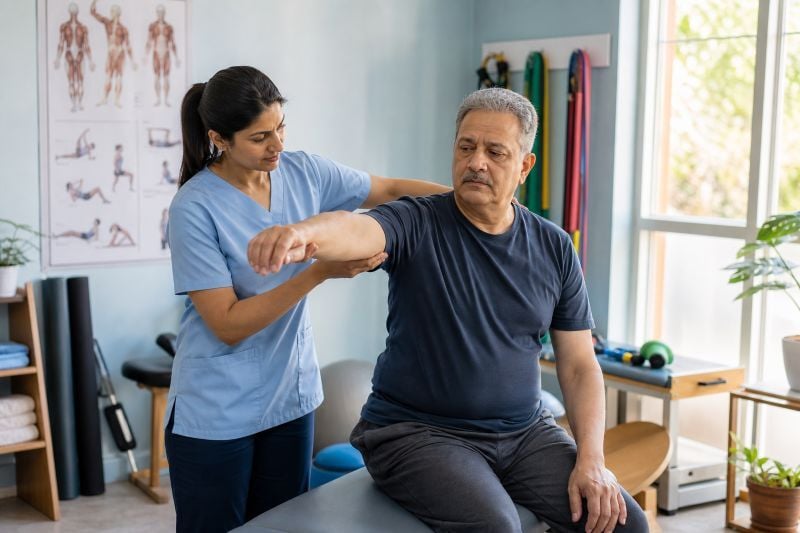
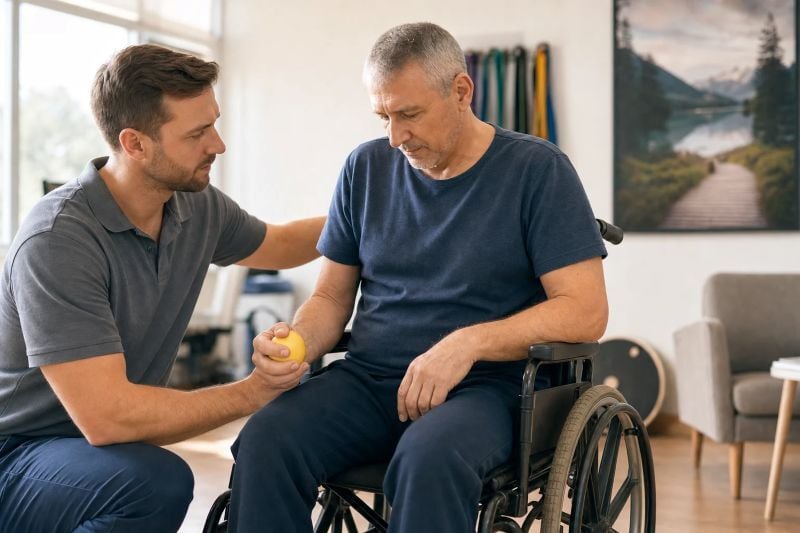
A stroke physiotherapist assesses your movement, strength, balance, walking and arm function, then builds a personalised programme of task-specific exercises and hands-on techniques. The aim is to help you reach your own priorities — walking safely, using your affected arm, managing stairs or returning to hobbies — while reducing your risk of falls.
Every stroke is different, so your programme is built around your specific difficulties and goals:
| Common post-stroke problem | How physiotherapy helps |
|---|---|
| Hemiparesis / hemiplegia (one-sided weakness) | Strengthening and repetitive, task-specific training |
| Spasticity (muscle tightness or stiffness) | Stretching, positioning, movement retraining, managed with the multidisciplinary team |
| Gait problems and foot drop | Gait re-education; functional electrical stimulation combined with physiotherapy |
| Balance problems and falls risk | Balance, standing and functional training |
| Shoulder pain and subluxation | Assessment of the cause, positioning advice and targeted strengthening |
| Fatigue | Graded, paced activity and cardiovascular fitness training |
Shoulder problems are common — studies report hemiplegic shoulder pain in a substantial minority of survivors, and it is more likely where there is arm weakness or spasticity — so early assessment matters. As NICE NG236 advises, we assess shoulder pain to identify its cause before deciding how to manage it. You can read more about the wider range of conditions we treat at our Hanwell clinic.
Which physiotherapy techniques are used in stroke rehabilitation?
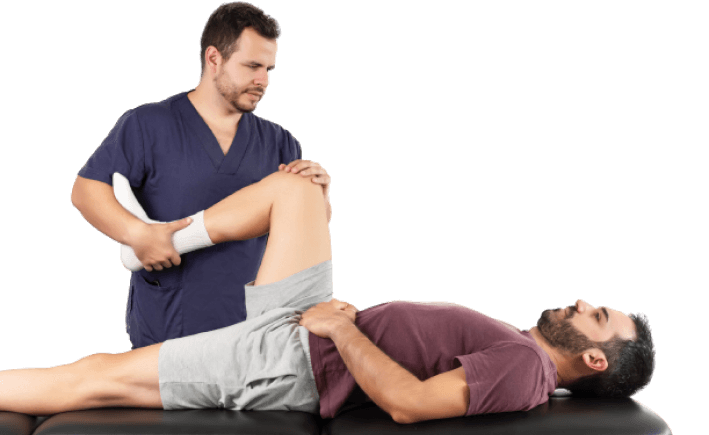
Evidence-based techniques include repetitive task-specific training, strength and balance work, gait re-education, functional electrical stimulation (FES), mirror therapy and cardiovascular training. These are combined and tailored to your stage of recovery and personal goals, rather than applied as a one-size-fits-all package.
What the evidence shows:
- Repetitive, task-specific training — the primary recommended motor-recovery approach in the 2023 National Clinical Guideline for Stroke. A 2025 Cochrane review (Todhunter-Brown et al.) concluded that physical rehabilitation using a mix of treatment components likely improves recovery of function and mobility after stroke, and that additional rehabilitation delivered as an adjunct may provide added benefits.
- Functional electrical stimulation (FES) — for foot drop, systematic-review evidence suggests FES can improve post-stroke walking speed when combined with physiotherapy.
- Mirror therapy — a Cochrane review (Thieme et al.) found mirror therapy produced a modest improvement in upper-limb motor function as an adjunct to conventional rehabilitation.
- Constraint-induced movement therapy (CIMT) — Cochrane evidence reports limited improvements in arm motor function, with less certain effects on longer-term disability.
- Technology (virtual reality, treadmill and robotics) — can add training intensity and motivation, but the evidence is mixed. We use technology selectively as an adjunct, not a replacement for hands-on therapy.
At CK Physio we combine hands-on treatment with active, task-specific exercise and, where clinically appropriate, electrotherapy and neuromuscular stimulation, always as part of a personalised plan delivered by a Chartered Physiotherapist. Learn more about our approach to physiotherapy in West London.
How does private stroke physiotherapy work alongside the NHS?
Private physiotherapy is designed to complement, not replace, your NHS care. After hospital, many people receive NHS Early Supported Discharge (ESD) — typically up to six weeks of home-based, specialist rehabilitation for people with mild-to-moderate stroke. Private physiotherapy can add extra sessions during that period, continue therapy once NHS input ends, or help if you were not eligible for ESD.
NHS stroke teams provide excellent care, but capacity is finite. The Sentinel Stroke National Audit Programme (SSNAP) reports for recent years have shown that the proportion of patients receiving a six-month review has declined, and that a meaningful minority of patients still report moderate-to-severe mood issues at six months. Extra, goal-focused private practice — at a frequency that suits you — can help bridge that gap. We work around your NHS team and encourage you to keep your GP and stroke specialists informed throughout. For older adults balancing multiple health needs, our guide to physiotherapy for older adults may also be useful.
How long does stroke rehabilitation take?
Recovery time varies with the size and location of your stroke, your general health and other individual factors. The most rapid gains usually occur in the first three to six months, with progress often continuing for a year or more. There is no fixed endpoint — with continued rehabilitation, improvements remain possible over the long term.
We set realistic, measurable goals with you and review them regularly. Recovery is rarely a straight line, so we adjust your programme as you progress and mark meaningful functional milestones — walking a little further, standing more steadily, or dressing more independently. We avoid promising specific timescales, because honest, individualised expectations are part of good care.
Can physiotherapy help with speech or cognitive problems after a stroke?
Physiotherapy focuses on physical recovery — movement, balance, strength and walking. Speech, language and swallowing difficulties (including aphasia) are managed by speech and language therapists, and thinking, memory and daily-living skills by occupational therapists. Stroke recovery is a team effort, and we can help point you toward the right professionals.
As part of a whole-person, multidisciplinary approach, we consider how fatigue, mood and confidence affect your physical rehabilitation, and we welcome family involvement at every stage.
Frequently asked questions
Do I need a GP referral to see a private physiotherapist after a stroke?
No — you can book directly with CK Physio. We are happy to liaise with your NHS stroke team and GP so your care is joined up.
Can you visit me at home?
Yes. We offer home-visit physiotherapy across West London for people who find travelling to the clinic difficult after a stroke.
What should I wear to a session?
Comfortable, loose-fitting clothing that allows easy movement, and supportive, non-slip footwear.
Can I have physiotherapy if I have other health conditions?
Yes. Your programme is assessed and tailored around all of your health needs to keep it safe and effective.
How can my family support my recovery?
Encouraging your home-exercise programme, supporting attendance and offering motivation all make a real difference — and we guide families on how to help safely.
Is physiotherapy safe soon after a stroke?
Physiotherapy begins once your medical team confirms you are stable, and we always work within safe, individualised limits.
Start your recovery with CK Physio
Recovery after a stroke is a marathon, not a sprint — and you don’t have to face it alone. Our Chartered Physiotherapists in Hanwell provide caring, evidence-based stroke rehabilitation for people across Ealing and West London, in clinic or at home.
This article is for general information and is not a substitute for individual clinical advice. If you think you or someone else is having a stroke, call 999 immediately.
Author & Reviewer
This guide was written and clinically reviewed by the chartered physiotherapy team at CK Physio, a West London physiotherapy practice established in 2003. All clinicians named on our website are registered with the Health and Care Professions Council (HCPC) and hold chartered status through the Chartered Society of Physiotherapy (MCSP).
References
- National Institute for Health and Care Excellence (2023). Stroke rehabilitation in adults (NG236). nice.org.uk/guidance/ng236
- Intercollegiate Stroke Working Party (2023). National Clinical Guideline for Stroke for the UK and Ireland. strokeguideline.org
- Royal College of Physicians. National Clinical Guideline for Stroke. rcplondon.ac.uk
- Stroke Association. Stroke statistics. stroke.org.uk/what-is-stroke/stroke-statistics
- Sentinel Stroke National Audit Programme (SSNAP). National audit results. strokeaudit.org
- Todhunter-Brown A et al. (2025). Physical rehabilitation approaches for the recovery of function and mobility following stroke. Cochrane Database of Systematic Reviews, CD001920. cochrane.org/CD001920
- Thieme H et al. Mirror therapy for improving motor function after stroke. Cochrane Database of Systematic Reviews, CD008449. cochrane.org/CD008449
- NHS. Recovery — Stroke. nhs.uk/conditions/stroke/recovery




.svg)

.svg)

.svg)