
9. June 2026
Postnatal physiotherapy is the evidence-based way to recover from the musculoskeletal effects of pregnancy and childbirth — back pain, pelvic-floor dysfunction, diastasis recti, coccydynia, wrist pain — that affect roughly 1 in 2 new mothers but go largely unaddressed by the standard 6-week GP check. This guide explains what's happening to your body, what's safe to do and when, the strongest current evidence on diastasis recti and pelvic-floor recovery, the realistic timeline back to running and full activity, and how CK Physio supports new mothers across Hanwell, Ealing and West London — including in-home assessments so you don't have to leave your baby.
Postnatal Recovery by the Numbers
~50%
of postpartum women experience significant musculoskeletal pain
31%
have urinary incontinence at 12 months postpartum (mostly stress UI)
39%
still have diastasis recti (>2cm) at 6 months postpartum
12+ wks
recommended minimum before returning to running (Goom 2019 framework)
What does postnatal recovery actually involve?
Postnatal recovery is the gradual rebuilding of pelvic-floor function, abdominal wall integrity, spinal stability and overall fitness after pregnancy and birth — typically over 6 to 12 months, not 6 weeks. The official UK postnatal pathway (under NICE NG194) includes midwife and health visitor contacts and a GP check at around 6 to 8 weeks. That check screens for obstetric complications and mental health — but rarely includes a structured assessment of pelvic floor, abdominal wall or musculoskeletal recovery.
That gap matters. The body recovering from pregnancy is doing several distinct jobs in parallel: closing a 2–4 cm separation in the abdominal wall (diastasis recti), rebuilding pelvic-floor strength after stretch and possibly tear injury, recovering from the cumulative postural load of nine months of bump-carrying, and now learning to lift, feed, settle and carry an infant — which is, biomechanically, repeated forward-flexed lifting under fatigue, with disrupted sleep. No wonder roughly half of new mothers end up in pain.
Postnatal physiotherapy — sometimes called women's health physiotherapy or postnatal MOT — is the layer that most NHS pathways don't routinely include. A specialist assessment with a chartered physiotherapist typically covers pelvic-floor function, abdominal wall integrity, lower-back and pelvic-girdle pain, scar mobility (C-section or perineal), feeding/lifting posture, and a structured plan for safe return to exercise and sport.
How common are postnatal aches and pains? The evidence
Roughly 1 in 2 new mothers experiences musculoskeletal pain after childbirth, and a substantial proportion still has it 6 months later — which is why "wait and see" is no longer the right default. Here's what the data actually shows:
- 49.8% of postpartum women report pain after childbirth (mean Pain Rating Index 7.35 on the McGill questionnaire).
- 53% have persistent lower back pain after birth; 70% of cases start in the first month postpartum.
- Only 28.9% have resolved their LBP by 6 months postpartum — meaning ~71% are still managing pain that affects daily life in 75% of those women.
- Pelvic-girdle pain — pain in the front or back of the pelvis — affects 27% of women at 14 weeks postpartum, with notably higher prevalence (38%) in some ethnic groups.
- Urinary incontinence affects 24% at 6 weeks, dips to 21% at 3 months as natural healing progresses, then climbs back to 32% by 12 months as load increases (lifting, return to running). Stress UI accounts for 54% of cases.
- Diastasis recti (rectus abdominis separation >2cm) is essentially universal at delivery, falls to 39% by 6 months, and persists at ~30% in some women for life.
- Levator avulsion — partial detachment of the deep pelvic-floor muscle — occurs in 13–36% of vaginal deliveries, often without symptoms in the first weeks but predicting prolapse risk later.
The biggest predictors of persistent back pain aren't C-section vs vaginal birth, BMI or epidural use — they are pre-existing back pain (especially in previous pregnancies) and the volume of household and infant-care tasks. That's important because the second factor is modifiable. Sharing infant-care and household tasks where possible may help.
Common postnatal MSK problems and what to do about them
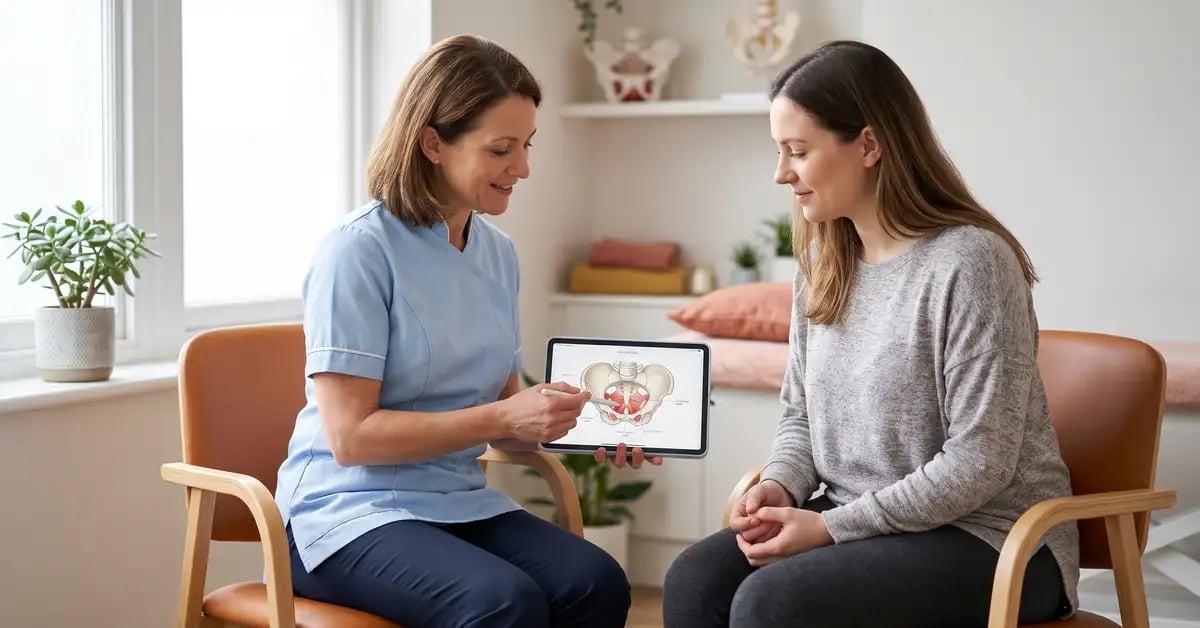
A proper pelvic-floor assessment is the difference between “just do your Kegels” and an actual recovery plan.
The most common postnatal physiotherapy presentations cluster into six conditions: lower-back and pelvic-girdle pain, pelvic-floor dysfunction, diastasis recti, coccydynia, C-section scar issues, and feeding-related upper-limb problems (de Quervain's, carpal tunnel, thoracic spine pain). Most respond well to structured rehabilitation when assessed early.
Lower-back and pelvic-girdle pain
Triggered most often by household chores (57%), prolonged standing (54%), prolonged sitting/feeding (52%) and lifting the baby. Treatment combines deep core retraining, manual therapy where indicated, and pragmatic ergonomic advice about feeding posture and infant handling. Most cases settle within 6–12 weeks of structured rehabilitation.
Pelvic-floor dysfunction
Symptoms include leakage with cough/sneeze/jump (stress UI), urgency or frequency, heaviness or dragging in the pelvis (suggestive of prolapse), or pain during sex. A specialist women's-health physiotherapy assessment — typically including internal pelvic-floor examination — is the only way to know whether you're contracting the right muscles. Up to 50% of women asked to do a pelvic-floor contraction without examination either can't isolate the muscles or actively bear down. NICE NG123 recommends supervised pelvic-floor muscle training as first-line treatment for stress UI.
Diastasis recti (abdominal separation)
Universal at delivery; resolves spontaneously in around 60% of women by 6 months. The remaining 39% with persistent >2cm separation benefit from structured rehabilitation. Critically, traditional sit-ups, crunches, planks and Pilates “Hundred”-style exercises are contraindicated in early postpartum and can worsen the gap. Evidence-based progression starts with diaphragmatic breathing, transverse abdominis activation, and the Sahrmann progression — gradually loading the deep core through controlled leg movements without bulging the abdominal wall. Surgical repair (abdominoplasty) is rarely needed.
Coccydynia (tailbone pain)
Common after a long second stage, an instrumental delivery, or a baby's posterior position pressing the tailbone backward. Sitting on hard surfaces, transferring from sit-to-stand and feeding sessions all aggravate. Treatment combines specific tailbone manual mobilisation and cushion/seating advice. Most resolve within 4–8 weeks of treatment.
C-section scar adhesion and abdominal weakness
Scar tissue can tether overlying skin and underlying fascia, restricting movement, contributing to back pain and producing strange sensations on exertion. From around 6–8 weeks (once the wound is fully healed and approved by your GP), gentle scar massage and progressive abdominal retraining accelerate recovery. C-section mothers also need a longer onramp before high-impact activity (typically 16+ weeks).
Feeding-related upper-limb pain
De Quervain's tenosynovitis (thumb-side wrist pain), “mother's wrist”, carpal tunnel symptoms (often persistent from pregnancy fluid retention) and upper-back / shoulder pain are all common from the repeated holding, lifting and breastfeeding posture of the early months. Splinting, ergonomic adjustment of feeding position and targeted strengthening usually resolves things within 6–8 weeks of treatment.
What's safe to do, and when? The postnatal recovery timeline
Postnatal recovery is a graded re-introduction of load — not a binary “cleared at 6 weeks.” Safe progression looks like this:
Weeks 0–2
Settle & gentle activation
Diaphragmatic breathing, gentle pelvic-floor “lifts”, postural awareness when feeding, gentle walking, scar care for C-section. No formal exercise.
Weeks 2–6
Restore foundations
Progressive pelvic-floor work, deep core / Sahrmann progression, longer walks, postural corrections. Postnatal physio assessment is ideal here.
Weeks 6–12
Build capacity
Low-impact strength work (bodyweight, light resistance), Pilates / yoga adapted for postnatal, swimming once lochia stops, brisk walking. Still no running.
Weeks 12+
Return to impact
Run/walk progression for vaginal-delivery mothers (16+ wks for C-section). Add high-impact slowly. Pelvic-floor capacity tests before each progression.
This timeline draws on advice from the Pelvic, Obstetric and Gynaecological Physiotherapy network (POGP) and the 2019 Goom-Donnelly-Brockwell “Returning to Running Postnatal” guidelines. Anyone telling you to start running at 6 weeks because you feel fine is offering a 1990s standard, not 2026 evidence.
Diastasis recti: the evidence-based exercise progression
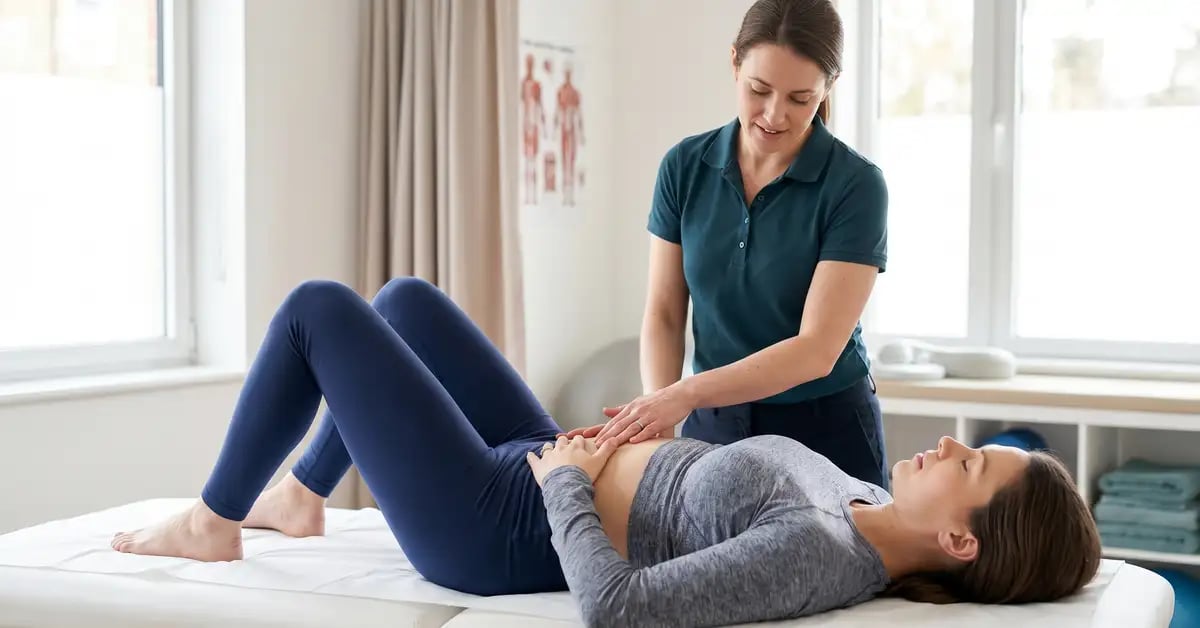
Deep-core retraining starts with breath, not with the obvious abs.
The evidence supports a graded transverse abdominis (TA) and pelvic-floor activation progression — typically the Sahrmann sequence — as the safest and most effective way to recover diastasis recti. Aggressive crunching makes it worse. Here's a typical progression:
- Stage 1 — Diaphragmatic breathing + TA activation (weeks 0–2): Lying on your back, knees bent. Inhale into your ribs and belly; on exhale, gently draw the lower belly toward the spine without holding the breath. 10 reps, 3× daily.
- Stage 2 — Heel slides (weeks 2–4): Same starting position. On exhale + TA contraction, slowly slide one heel along the floor away from you and back. 10 each side. Stop if you see “doming” of the abdominal wall.
- Stage 3 — Knee fall-outs (weeks 3–5): Same starting position. Keeping the pelvis still, slowly let one knee drop out to the side and bring it back, maintaining TA engagement. 10 each side.
- Stage 4 — Single-leg lifts (weeks 4–6): Same starting position. Bring one knee toward your chest, then extend the leg, then return. 10 each side.
- Stage 5 — Tabletop progressions (weeks 6+): Both knees up to 90°, alternate slow leg extensions/lowering, then both legs together once tolerated. Always with TA pre-activation.
- Stage 6 — Loaded core (weeks 8+): Bird-dog, dead bugs with weights, side-plank progressions, hip thrusts. By this stage, the rectus is usually closing meaningfully.
Three principles run through every stage: exhale on effort, never bulge the abdominal wall, and pre-activate the pelvic floor. If you see a “doming” ridge in the centre of your abdomen during an exercise, you've progressed too fast — drop back a stage and re-establish control.
It's never too late to do this work. Women presenting years after delivery still close the gap meaningfully with consistent core rehabilitation. Surgery (abdominoplasty) is reserved for cases with significant functional impairment or umbilical hernia.
Pelvic-floor recovery: what the evidence supports
Supervised pelvic-floor muscle training is the first-line treatment for postnatal urinary incontinence and prolapse symptoms — recommended in NICE NG123, with good evidence from randomised trials, including the UK POPPY trial (Hagen et al., The Lancet, 2014), that individualised pelvic-floor training improves prolapse symptoms. Two things really matter: doing the contractions correctly, and doing them often enough.
The standard prescription:
- Slow contractions: Lift, hold for 10 seconds, then fully release for 10 seconds. 10 reps.
- Fast contractions: Lift quickly and fully release. 10 reps.
- Frequency: 3 sets of each, daily, for 16+ weeks before judging progress.
- Positions: Start lying down, progress to seated, then standing. Eventually integrate into functional tasks (lift baby = pelvic-floor pre-activation).
The single biggest mistake is technique. Up to half of women asked to do a pelvic-floor contraction without examination engage the wrong muscles (gluteals, abdominals, inner thigh) or actively push down. A specialist women's-health physiotherapy assessment — including internal palpation when appropriate — confirms you're using the correct muscles, which dramatically improves the effectiveness of every subsequent contraction.
Pelvic floor problems: CK Physio doesn't offer specialist pelvic health physiotherapy. If you have pelvic floor symptoms, such as leaking urine, speak to your GP. The NHS says a GP can refer you to your local NHS continence service, which includes specialist physiotherapists, and in some cases you may be able to refer yourself (see the NHS guidance on urinary incontinence treatment).
Returning to running and high-impact exercise

Returning to running too early can increase the risk of pelvic-floor symptoms.
The 2019 Goom, Donnelly & Brockwell “Returning to Running Postnatal” guidelines recommend a minimum of 12 weeks postpartum (16+ for C-section) before any running, and only after passing key strength and load-tolerance tests. Returning too early can increase the risk of pelvic-floor symptoms and back pain.
A typical pre-running checklist (passed before progressing to run-walk):
- 30 minutes brisk walking pain-free
- Single-leg squat 10 reps each side without wobble
- Single-leg calf raise 20 reps each side
- Side-lying hip abduction 20 reps each side
- Forward jumping/hopping x10 each side without leakage, prolapse symptoms or pain
- Pelvic-floor contraction held for 10 seconds, repeated 10 times, plus 10 fast pulses
If any of those produces leakage, heaviness or pain — you're not ready. Take 2–4 more weeks of capacity-building and retest. The standard run-walk progression starts at 1 minute run, 2 minutes walk for 20 minutes, building over 4–6 weeks back to continuous running.
For higher-impact activities (CrossFit, HIIT, plyometrics, rugby, netball), we generally suggest 16–20 weeks postpartum minimum, with a similar capacity-test framework. Returning to heavy lifting follows the same principle: rebuild capacity progressively, with pelvic-floor pre-activation built into every rep.
When should you see a postnatal physiotherapist?
Every new mother benefits from at least one postnatal physiotherapy assessment in the first 12 weeks postpartum — the earlier the better. But there are specific situations where it shifts from “helpful” to “essential”:
- Any leakage of urine or stool, even occasional
- A feeling of heaviness or bulge in the vagina, especially worse end of day or after lifting
- Persistent back, pelvic-girdle or hip pain beyond 6 weeks
- Persistent diastasis — you can fit two or more fingers width into the gap above the navel
- C-section scar that's painful, tethered or sensitive beyond 8 weeks
- Coccydynia — persistent tailbone pain when sitting
- Pain during sex after the standard postnatal check (dyspareunia is not normal)
- Wrist pain from feeding/lifting that's not settling with rest
- Wanting to return to running, sport or heavy lifting — capacity testing protects you
Red flags — contact your GP or maternity team urgently:
- Heavy or sudden vaginal bleeding (soaking a pad an hour) or passing large clots
- Foul-smelling discharge, fever >38°C or signs of wound infection
- Severe headache, visual disturbance or swelling (possible postpartum pre-eclampsia)
- Calf swelling, pain or breathlessness (possible deep vein thrombosis or PE)
- New severe abdominal pain or unexplained weight loss
- Thoughts of harming yourself or your baby (postnatal mental health needs urgent support)
Why home-visit postnatal physiotherapy makes sense

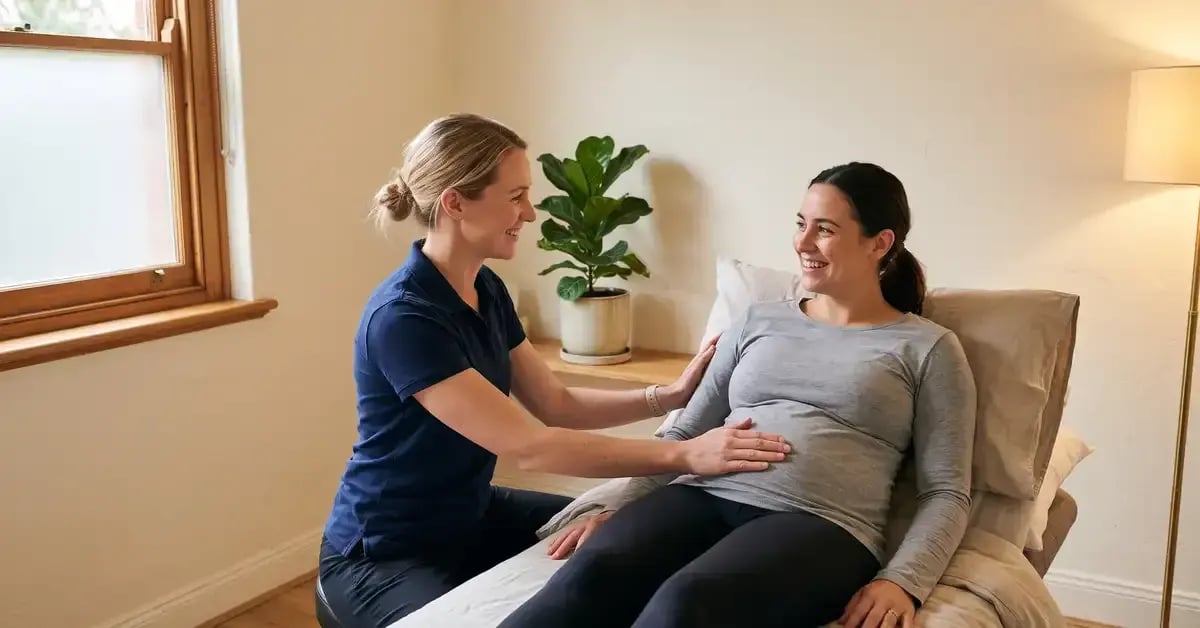
Home-visit physio means no travel, no stress, and your physio can assess your actual feeding posture and infant handling.
For postnatal mothers in the first 12 weeks, a home-visit physiotherapy assessment removes the biggest barrier to early intervention — travel friction with a newborn — and produces a more useful assessment because we can see your real feeding chair, baby-carrier, sleeping position and lifting habits.
CK Physio's home-visit service (£130, selected West London postcodes) is particularly well-suited to early postpartum care. A typical home assessment includes:
- Full postural and lifting-mechanics review in your actual environment
- Feeding-position assessment (the single biggest cause of upper-back, neck and wrist pain)
- Abdominal-wall and pelvic-girdle assessment on your own treatment surface
- Baby-handling demonstration (lifting from cot, car seat installation, pram pushing)
- Personalised exercise prescription you can do during nap-windows
- No travel, no waiting room, no need to time-table around a feed
For mothers with mobility limitations after C-section, severe back/pelvic-girdle pain, or simply a baby who is not yet sleeping enough to leave the house, home-visit care isn't a luxury — it's the only way the assessment actually happens. Removing the journey also makes it easier to keep going with your programme.
How CK Physio supports postnatal recovery in West London
CK Physio helps with the musculoskeletal side of postnatal recovery — back, pelvic-girdle, wrist and abdominal-wall problems — across Hanwell, Ealing and the surrounding West London area, with clinic appointments in Hanwell, home visits in selected West London postcodes, and chartered physiotherapists recognised by BUPA, AXA PPP, WPA, Groupama and Life UK, with over 20 years' experience.
A typical postnatal pathway looks like this:
- Initial postnatal assessment (up to 45 minutes) (weeks 4–12 ideally): Full history including birth experience, MSK assessment, abdominal-wall assessment, scar review, posture and lifting analysis, treatment plan.
- Foundation phase (3–5 sessions over 6–8 weeks): Core rehabilitation, manual therapy as needed, scar work, ergonomic correction.
- Capacity phase (3–4 sessions over 8–12 weeks): Progressive strength work, return to specific activities (walking, swimming, gym), addressing any persistent symptoms.
- Return-to-sport phase (where applicable): Capacity testing, run-walk progression, individualised return to running / impact / heavy lifting.
At CK Physio, an initial assessment and treatment costs £80, follow-up sessions cost £65 and a home visit costs £130; our bookings page carries the live fee schedule. CK Physiotherapy is recognised by BUPA, AXA PPP, WPA, Groupama and Life UK, and our chartered physiotherapists are HCPC-registered members of the Chartered Society of Physiotherapy.
Frequently asked questions
How long does postnatal recovery take?
Tissue healing largely completes by 6–8 weeks, but full musculoskeletal and pelvic-floor recovery typically takes 6–12 months — longer for first-time mothers, after C-section, or after a complicated birth. Most women feel substantially better by 3 months with the right support; full return to running and high-impact exercise sits at 12–20 weeks. The phrase “back to normal at 6 weeks” is a clinical myth that the evidence has thoroughly debunked.
Is the 6-week GP check enough postnatal care?
For most women, no — not for musculoskeletal recovery. The standard 6-week check screens for obstetric complications and mental health and rarely includes a pelvic-floor or abdominal-wall examination. Up to 20–40% of vaginal deliveries result in pelvic-floor avulsion injuries that aren't visible during a routine check. A specialist postnatal physiotherapy assessment is the layer most NHS pathways don't include but most women benefit from.
What is diastasis recti and is it serious?
Diastasis recti is separation of the abdominal muscles along the central tendon (linea alba) that occurs to some degree in essentially all pregnancies. It's normal during pregnancy and not dangerous in itself. By 6 months postpartum, ~60% of women have spontaneously closed back to under 2cm; the remaining 39% benefit from structured deep-core retraining. Serious complications (umbilical hernia, severe functional impairment) are uncommon and surgical repair is rarely needed.
When can I start exercising after birth?
Day one for gentle pelvic-floor activation and diaphragmatic breathing. Walking from week one (start short). Pelvic-floor and deep-core work from week two for vaginal birth, week three for C-section. Low-impact strength work from week 6 once cleared. High-impact (running, jumping, plyometrics) from week 12 minimum (16+ for C-section) and only after passing capacity tests. Don't take "I feel fine at 6 weeks" as evidence you're ready — the pelvic floor and connective tissue need longer than the muscle does.
Is it too late to do postnatal physiotherapy if my baby is older?
No. Mothers presenting years after delivery still benefit substantially from structured pelvic-floor and core rehabilitation. The diastasis recti literature explicitly supports late intervention. Persistent stress urinary incontinence responds well to supervised pelvic-floor muscle training even decades after the original birth. Postnatal physiotherapy is calibrated for whoever turns up — first 12 weeks is ideal, but never written off if you're outside that window.
Is leakage of urine after birth normal?
Common, but not normal in the sense that it should be ignored. Around 24% of women have stress urinary incontinence at 6 weeks postpartum, falling to 21% at 3 months, then climbing back to 32% by 12 months as activity load increases. NICE recommends supervised pelvic-floor muscle training as first-line treatment — with strong evidence of effectiveness. If you're leaking when you cough, sneeze, jump or run, speak to your GP, who can refer you to your local NHS continence service (CK Physio doesn't offer pelvic health physiotherapy). Don't accept it as the cost of motherhood; it's reliably treatable.
Can postnatal physiotherapy help with pain during sex?
Yes. Postpartum dyspareunia is common but often comes from treatable causes — perineal scar tightness, pelvic-floor overactivity, healing tissue sensitivity or musculoskeletal contributions. A women's-health physiotherapist can identify the specific drivers and provide tailored treatment (scar mobilisation, pelvic-floor downtraining, education about positioning and pacing, sometimes a structured graded re-introduction programme). It's not a permanent change you have to live with. CK Physio doesn't offer this kind of treatment, so ask your GP about a referral.
Recovering from birth?
Book a postnatal physiotherapy assessment with CK Physio
Postnatal back, pelvic-girdle and wrist pain care for new mothers across Hanwell, Ealing and West London — in clinic or at home, no need to leave your baby. Established 2003. Recognised by BUPA, AXA PPP, WPA, Groupama and Life UK.
Clinically reviewed by
CK Physio Clinical Team
HCPC-registered Chartered Physiotherapists, members of the Chartered Society of Physiotherapy, delivering postnatal physiotherapy across Hanwell, Ealing and West London since 2003. Recognised by BUPA, AXA PPP, WPA, Groupama and Life UK.
Sources & further reading: NICE NG194 Postnatal care; NICE NG123 Urinary incontinence and pelvic organ prolapse in women; Hagen et al. PROMISE trial pelvic floor muscle training for prolapse; Goom, Donnelly & Brockwell 2019 “Returning to Running Postnatal” guidelines; Sahrmann diastasis recti progression; Pelvic, Obstetric & Gynaecological Physiotherapy network (POGP); Chartered Society of Physiotherapy guidance on women's health; Health and Care Professions Council professional standards.




.svg)

.svg)

.svg)