

19. May 2016
Physiotherapy in the UK now spans in-person hands-on care, video consultations, clinician-prescribed exercise apps, and — since 2024 — regulated autonomous AI clinics on the NHS. The evidence supports digital physiotherapy for many straightforward musculoskeletal problems, while complex, painful, post-surgical, and neurological presentations continue to benefit from face-to-face assessment by a chartered physiotherapist.
Ten years ago, "technology in physiotherapy" mostly meant the machines you saw at the clinic — an ultrasound head, a TENS unit, a shockwave probe. In 2026, the bigger shift is what technology can now do outside the clinic: video consultations that meet NHS standards, exercise apps used by major private hospital groups, and AI-powered clinics that treat some conditions without a human clinician in the loop. This guide is a plain-English map of what changed, what the evidence shows, and how to decide which type of physiotherapy fits your problem.
What counts as "physiotherapy technology" today?
It helps to sort the field into three groups, because the evidence and safety questions differ for each.
- Tools your clinician uses with you — the machines used inside a clinic: ultrasound imaging, therapeutic ultrasound, electrotherapy, shockwave, and objective movement-assessment tools. These sit alongside hands-on treatment.
- Digital tools that support you between (or instead of) in-person sessions — video consultations, clinician-prescribed exercise apps such as Physitrack or Rehab Guru, wearable activity trackers, and outcome questionnaires. Your physiotherapist stays in charge; the technology carries information back and forth.
- Autonomous digital clinics — regulated services in which an AI system, not a human clinician, assesses and treats you within a defined scope. Flok Health, the first of these on the NHS, is the current UK example.
The distinction between the second and third groups is what patients most often get wrong. An exercise app prescribed by your physiotherapist is not the same thing as an AI clinic that replaces the clinician.
What has changed in UK physiotherapy since 2022?
The last four years have moved digital physiotherapy from pandemic workaround to formal part of NHS strategy. Four developments matter for patients:
- The NHS 10-Year Health Plan for England (2025) commits to a "decisive push from analogue systems to digital solutions", with rehabilitation named as a core service. The CSP has welcomed this while pressing for adequate physiotherapy workforce numbers to deliver it (CSP).
- CSP-endorsed NHS England guidance now treats remote consultations in adult MSK physiotherapy as a normal option within a blended service, not a fallback (NHS England).
- NICE guidance HTG712 (formerly HTE16) says four digital technologies “can be used in the NHS while more evidence is generated to manage non-specific low back pain in people 16 years and over” (NICE, 2024).
- The CSP's Physiotherapy Health Informatics Strategy 2022–27 is now supported by a free foundation-level digital and data course, launched with NHS England in November 2025 (CSP).
Digital physiotherapy is now part of ordinary UK care, not an experiment. The live question is which patient benefits most from which type of care.
What does the evidence say about virtual and remote physiotherapy?
Virtual physiotherapy — a video or telephone consultation with a chartered physiotherapist — has been evaluated in a series of NHS studies since the pandemic. A 2023 systematic review of digital versus face-to-face musculoskeletal physiotherapy assessment found reliability ranging from moderate to excellent for clinical tests, joint range of motion, patient-reported outcome measures, and management decisions. Reliability for assessing spinal posture from video alone was less consistent (Cottrell et al., 2023, PMC).
Practical experience from NHS trusts shows a similar pattern. A service evaluation at Guy's and St Thomas' NHS Foundation Trust in London, surveying more than 1,400 musculoskeletal physiotherapy patients, found that most participants who used the PhysiApp mobile exercise application found it easy to use and felt it added value to their treatment. Digital exclusion, login problems, and situations where patients felt confident exercising unsupported were the main barriers (Grodon et al., 2024, PMC).
If you want a deeper look at what virtual physiotherapy is, how to prepare for a session, and when it fits, our guide to virtual physiotherapy in the UK covers this in detail. For patients who cannot easily travel to a clinic, our separate home visit physiotherapy guide sets out the alternative in-person option.
What is AI physiotherapy and how does it work?
AI physiotherapy, in the strict sense, is a service in which an artificial intelligence system carries out the clinical role a physiotherapist would normally perform — taking a history, deciding on a plan, prescribing and progressing exercises, and monitoring symptoms — within a regulated scope of practice.
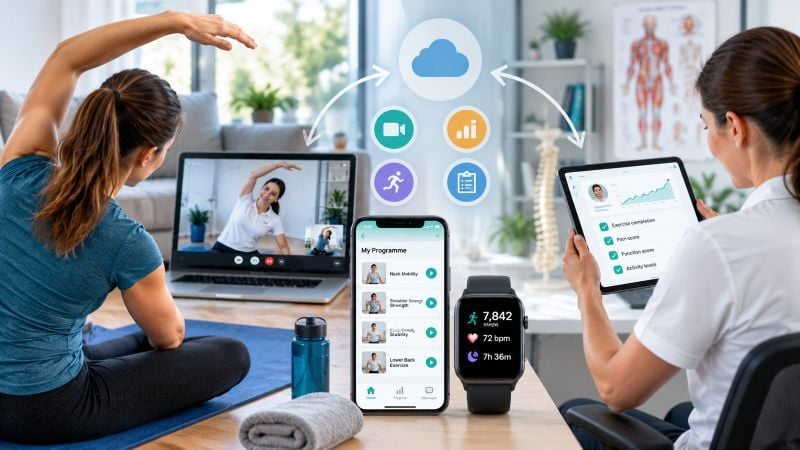 The UK example is Flok Health. Its service uses a video-based digital physiotherapist that patients access through a smartphone app. It is registered with the Care Quality Commission and holds MHRA Class IIa medical device certification, extended in August 2026 from back pain and sciatica to all musculoskeletal and pelvic health pathways (Flok Health news). According to reporting, the service reached 14 NHS regions by August 2026 (Integrated Care Journal).
The published results are worth reading in context. In a 12-week pilot with Cambridgeshire Community Services NHS Trust in early 2025, Flok reports treating more than 2,500 back pain patients, cutting the back pain waiting list by more than half, and reducing MSK waiting times by around 44% within ten weeks. Of surveyed patients, 80% rated the AI experience as equivalent to or better than face-to-face physiotherapy (Health Innovation Network).
Two caveats matter. Those figures are self-reported by the provider and the commissioning trust; independent peer-reviewed long-term outcomes are still emerging. And the CSP has been clear that AI has significant potential but does not replicate the clinical judgement of a chartered physiotherapist across complex or unusual presentations. In short: AI physiotherapy is real, regulated, and expanding on the NHS. For the patient groups it is designed for — most obviously uncomplicated non-specific low back pain and sciatica — it is a useful additional route. It is not the right tool for every problem.
Are exercise apps like Physitrack the same as AI physiotherapy?
No, and the distinction matters. Physitrack, Rehab Guru and Rehab My Patient are exercise prescription and adherence platforms used by clinicians. Your physiotherapist selects the exercises, sets the dose, and reviews how you get on. The app is a delivery tool; you remain the patient of a named chartered physiotherapist who is professionally accountable for your care.
These platforms are used routinely across the UK, including by major private hospital groups such as Bupa, Nuffield Health and Circle, and within NHS trusts. Patient survey evidence suggests they add most value when the programme is well explained and easily accessible, and less when the patient is already exercising confidently or the app itself is difficult to log into.
An autonomous AI clinic is the clinician. Both categories have a role, but they answer different questions: a chartered physiotherapist using a home-exercise app is treating you with a tool; an AI clinic is treating you without a human clinician making the decisions.
When do you still need to see a chartered physiotherapist in person?
Face-to-face assessment remains the right starting point in several situations. This is our clinical view, aligned with the CSP position that AI and digital services are best used alongside, not instead of, human clinical judgement for complex care. In-person physiotherapy generally makes more sense when:
- Your pain has multiple contributing factors, involves more than one region of the body, or has been going on for a long time without a clear pattern.
- You are recovering from surgery, a fracture, or a recent significant injury and need graded, closely monitored rehabilitation.
- You have a neurological condition — such as stroke, multiple sclerosis, or Parkinson's — where hands-on facilitation, balance work, and functional retraining are central.
- You are being treated for postnatal or women's health issues that involve internal or pelvic assessment.
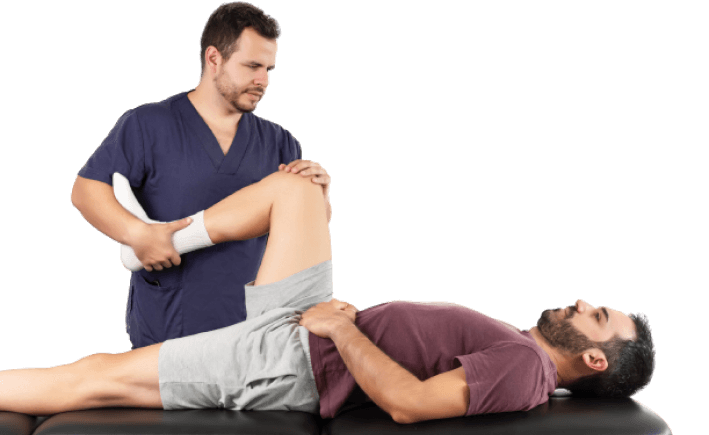
- You benefit clinically from hands-on techniques. Our separate guide on manual therapy at CK Physio explains what the evidence supports here.
- You are an athlete or an active person returning from a sports injury where sport-specific movement analysis is important. Our sports physiotherapy service in West London is built around this.
- You prefer to see a human clinician, or you struggle with app-based services for any reason, including limited internet access, English as a second language, or digital confidence.
A useful summary — one that Flok Health itself uses when triaging patients — is that autonomous digital services suit uncomplicated presentations in patients who can engage with a smartphone app, and refer more complex cases on to a clinician.
What about the technology inside physiotherapy clinics?
Clinic-based devices are the older, more familiar face of physiotherapy technology. They matter, but their role has become more targeted as the evidence has matured.
- Shockwave therapy is used for a defined set of tendon-related and calcific soft-tissue problems. Our shockwave therapy service page sets out what it is, who it may suit, and what a course of treatment looks like.
- Electrotherapy — including TENS, interferential and neuromuscular electrical stimulation — has a narrower evidence base than it once did. Current UK guidance recommends against several electrotherapy modalities as routine treatment for common conditions such as non-specific low back pain. Our electrotherapy service page is honest about where the evidence supports it and where it does not.
- Therapeutic ultrasound was once routinely applied to soft-tissue injuries and is now used more selectively. Our therapeutic ultrasound guide summarises the current position.
- Objective movement assessment tools — from simple video capture through to newer AI-assisted pose-estimation systems used in research settings — are becoming more common in specialist and elite-sport contexts, though their routine use in general MSK physiotherapy is still developing.
A modern chartered physiotherapist will pick from these tools where the evidence for your specific problem supports them, and set them aside where it does not. Technology in the clinic is a supplement to assessment, hands-on care, exercise prescription, and education — not a substitute for them. Our guide to current evidence-based physiotherapy techniques covers the wider picture.
How to decide what type of physiotherapy is right for you
A short decision framework, if you are weighing options:
- Rule out red flags first. See the safety box below — some symptoms need urgent medical assessment, not a physio app or a routine clinic booking.
- Consider complexity. A straightforward, recent, uncomplicated musculoskeletal problem in someone comfortable with smartphone apps often suits digital-first care. Complex, painful, post-surgical, neurological, or previously treated problems are better started with a face-to-face assessment.
- Check any digital service is regulated. UK clinical services should be registered with the Care Quality Commission if they deliver regulated activity, and AI clinics making autonomous decisions should hold MHRA medical device certification. Your treating clinicians should be registered with the HCPC.
- Ask what happens if things do not improve. A well-designed pathway, digital or in-person, always has a route to escalate when it is needed.
Safety: when to seek urgent medical care, not a physio app
Contact your GP, call NHS 111, or go to your nearest emergency department if you experience any of the following:
- New difficulty passing urine or new loss of bladder or bowel control
- Numbness around the back passage or genitals ("saddle" numbness)
- Progressive weakness or numbness in the legs, or difficulty walking
- Severe back or chest pain with fever, unexplained weight loss, or a history of cancer
- Signs of a stroke: sudden facial droop, arm weakness, or slurred speech (call 999)
- Sudden severe chest pain, or breathlessness at rest
A digital or AI physiotherapy service is not the right route for these symptoms. If you are not sure, err on the side of getting urgent advice. NHS guidance on when to go to A&E is a useful starting point.
Where CK Physiotherapy fits in this picture
CK Physio is a hands-on physiotherapy clinic in Hanwell, serving Ealing and West London since 2003. We are not an AI clinic and we do not claim to be one. What we offer is face-to-face assessment and treatment by chartered physiotherapists — clinicians registered with the Health and Care Professions Council and holding MCSP status through the Chartered Society of Physiotherapy.
Where digital tools add value — for example a home-exercise programme between sessions — we use them. Where the answer to your problem is careful assessment, hands-on treatment, and a rehabilitation plan built around your life, that is what we do in the clinic. In 2026, patients have more routes into physiotherapy than ever before. Our job is to be honest about which route fits which problem and help you choose well.
Frequently asked questions
Is AI physiotherapy safe?
Regulated AI physiotherapy services — registered with the Care Quality Commission and, where they make autonomous decisions, holding appropriate MHRA medical device certification — operate within a defined scope. Flok Health, the UK example, holds Class IIa certification and screens patients out of its pathway if their symptoms fall outside what it is designed to treat. Safety depends on that scope being clear.
Does the NHS use AI physiotherapy?
Yes. As of August 2026 the Flok Health service was live across 14 NHS regions covering more than 6.6 million patients, focused primarily on musculoskeletal and pelvic health pathways. Availability depends on your local commissioning arrangements, so ask your GP or check the Flok Health website directly.
Can AI physiotherapy replace a chartered physiotherapist?
The Chartered Society of Physiotherapy's position, which we share, is that AI has significant potential but does not replicate the expert clinical judgement of a human chartered physiotherapist, particularly for complex, painful, post-surgical, or neurological presentations. For the specific groups AI clinics are designed for, they offer a useful additional route. For everything else, a chartered physiotherapist is still the right first port of call.
What is the difference between a physio using an exercise app and an AI clinic?
A physiotherapist using an app such as Physitrack or Rehab Guru remains your clinician. The app is how they prescribe and monitor your exercises between sessions. An AI clinic replaces the clinician within a defined scope: the AI takes the history, decides the plan, and progresses your treatment.
How do I know if AI physiotherapy is right for my back pain?
Broadly, AI physiotherapy has been designed and evaluated for uncomplicated non-specific low back pain and sciatica in patients who can engage with a smartphone app. If you have red-flag symptoms (see the safety box above), a complex history, previous back surgery, or symptoms in more than one body region, an in-person assessment by a chartered physiotherapist or your GP is a safer starting point.
Do you use AI at CK Physiotherapy?
No. We are a hands-on clinic. Where digital tools help — for example, a home-exercise programme you can access between sessions, or a video consultation for a follow-up when travelling is difficult — we use them. Clinical decisions about your care are made by chartered physiotherapists, not by an AI system.
Are wearable trackers like Apple Watch or Fitbit useful for physiotherapy?
Consumer wearables can be useful for tracking general activity, walking, and sleep patterns, which are often relevant to musculoskeletal recovery. They are not designed as clinical assessment tools and their movement or posture data should not be treated as diagnostic. If a wearable helps you notice trends in your activity that you can then discuss with your physiotherapist, that is a reasonable use.
How much does AI physiotherapy cost?
Where Flok Health is commissioned through the NHS, it is free at the point of use for eligible patients in participating regions. Private access arrangements vary. For up-to-date pricing and eligibility, check with the provider directly.
Where can I find a chartered physiotherapist in West London?
You can search the Chartered Society of Physiotherapy's Physio2u directory, or contact us at CK Physio on 020 8566 4113. Our clinic is at 57 Elthorne Avenue, Hanwell, W7 2JY, and we serve patients across Ealing, Acton, Chiswick, Brentford, Southall, Greenford, and the wider West London area.
Prefer to see a chartered physiotherapist in person?
If you would rather have a face-to-face assessment with an HCPC-registered chartered physiotherapist in Hanwell, we would be glad to help.
About this guide
This guide was written and clinically reviewed by the chartered physiotherapy team at CK Physio, a West London physiotherapy practice established in 2003. All clinicians named on our website are registered with the Health and Care Professions Council (HCPC) and hold chartered status through the Chartered Society of Physiotherapy (MCSP).
Educational content only. If you have new, severe or worsening symptoms, or symptoms you are unsure about, please see a GP, call NHS 111 or seek urgent care. This article does not replace individual clinical assessment.
References
- Chartered Society of Physiotherapy. Physiotherapy Health Informatics Strategy 2022–27. Available at: csp.org.uk/professional-clinical/digital-physiotherapy/physiotherapy-health-informatics-strategy
- Chartered Society of Physiotherapy. NHS Long Term Plan for England: physiotherapy and rehabilitation position. Available at: csp.org.uk/campaigns-influencing/shaping-healthcare/nhs-long-term-plan-england
- Chartered Society of Physiotherapy. Digital and Data Foundations: practical skills for UK AHPs (September 2025). Available at: csp.org.uk/news/2025-09-12-digital-data-education-all-uk-ahps
- NHS England. Guide to adopting remote consultations in adult musculoskeletal physiotherapy services (endorsed by the CSP). Available at: england.nhs.uk
- National Institute for Health and Care Excellence (NICE). Digital technologies for managing non-specific low back pain: early value assessment, HTE16 (2024). Available at: nice.org.uk/guidance/hte16/chapter/1-Recommendations
- Grodon J, Tack C, Eccott L, Cairns MC. Patient experience and barriers of using a mHealth exercise app in musculoskeletal (MSK) Physiotherapy. PLOS Digital Health. 2024. Available at: ncbi.nlm.nih.gov/pmc/articles/PMC11458024/
- Cottrell MA, et al. Digital physiotherapy assessment vs conventional face-to-face physiotherapy assessment of patients with musculoskeletal disorders: A systematic review. 2023. Available at: ncbi.nlm.nih.gov/pmc/articles/PMC10030027/
- Health Innovation Network. AI-operated NHS physiotherapy clinic (Flok Health case study). Available at: thehealthinnovationnetwork.co.uk
- Integrated Care Journal. UK's first AI-powered physio more than halves back pain waiting lists (2025). Available at: integratedcarejournal.com
- Flok Health. Company news and coverage (2025–2026). Available at: flok.health/news
- Healthwatch. NHS physiotherapy: what people are telling us (May 2026). Available at: healthwatch.co.uk





.svg)

.svg)

.svg)