
Pregnancy · Women’s Musculoskeletal Health
Evidence-based physiotherapy for pregnancy back pain, pelvic girdle pain and sciatica. Safe, pregnancy-adapted care by Chartered Physiotherapists in Hanwell, Ealing and West London.
Written by Bryan Kelly, Chartered Physiotherapist, MCSP, HCPC-registered. Clinic founder, CK Physiotherapy, Hanwell.
Clinically reviewed by CK Physio Team, Chartered Physiotherapist, MCSP, HCPC-registered.
First published 7 April 2014 · Last reviewed 19 Oct 2026 · Next review due Oct 2027
Aches and pains are among the most common, and most draining, parts of pregnancy. If walking to the shops, climbing the stairs or simply turning over in bed has become a struggle, you are far from alone. This guide explains which pregnancy pains physiotherapy can help with, what the UK evidence and guidelines say, what treatment looks like at each stage of pregnancy, and which symptoms need a midwife or doctor rather than a physio.
Pregnancy Pain Physiotherapy: Back Pain, Pelvic Girdle Pain and More
At a glance
Aches in pregnancy are common but you do not simply have to put up with them. Pregnancy-adapted physiotherapy can help you move, sleep and work more comfortably, with care that changes as your bump grows.
- More than two-thirds of pregnant women have low back pain and almost one in five have pelvic pain, according to a Cochrane review of 34 trials.
- NICE advises considering referral to physiotherapy for women with pregnancy-related pelvic girdle pain, for exercise advice and a non-rigid support belt.
- Pelvic girdle pain (PGP) is not harmful to your baby, and most women with PGP can have a vaginal birth.
- Exercise is the best-supported treatment. Hands-on therapy, support belts and activity advice can be added as needed.
- After about 19 weeks, avoid lying flat on your back for long periods. Physiotherapy adapts to side-lying or supported positions.
- Bleeding, regular tightenings before 37 weeks, reduced baby movements, calf swelling or numbness around the bottom need urgent medical advice, not physiotherapy.
Is pain in pregnancy normal?
Pain in pregnancy is common but it is not something you simply have to accept. Back and pelvic pain affect most pregnant women to some degree, and much of it can be eased and managed. A Cochrane review of 34 randomised trials involving 5,121 women reported that more than two-thirds of pregnant women experience low back pain and almost one-fifth experience pelvic pain. Both tend to increase as pregnancy progresses and can interfere with work, daily activities and sleep.
Several things combine to cause it: the extra load of your growing baby, a shift in posture, changes in how your tummy, back and pelvic muscles work, and a nervous system that is naturally more sensitive in pregnancy. The hormone relaxin is often blamed, but NHS physiotherapy teams now point out that research has not shown a clear link between how mobile your joints are and how much pelvic pain you have. Pain is a real signal, but in pregnancy it rarely means damage.
Which pregnancy pains can physiotherapy help with?
Physiotherapy can help with the musculoskeletal pains of pregnancy: low back pain, pelvic girdle pain, sciatica-type leg pain, rib and upper back pain, and carpal tunnel syndrome in the hands. It can also advise on tummy muscle separation and on keeping active safely.
Pregnancy-related low back pain
Pregnancy-related low back pain is pain in the lower back above the pelvis, often a dull ache that builds through the day or with long periods of standing or sitting. It is the single most common pregnancy pain. It often responds well to staying active, targeted strengthening, pacing and small changes to posture during daily tasks. For context on how we approach non-pregnancy back pain, see our guide to chronic back pain management.
Pelvic girdle pain (PGP, formerly SPD)
Pelvic girdle pain (PGP) is pain in the joints of the pelvis: the pubic joint at the front, the sacroiliac joints at the back, or both. It can spread to the groin, hips, thighs or buttocks. It used to be called symphysis pubis dysfunction (SPD). The NHS estimates it affects up to 1 in 5 pregnant women to some degree. It typically hurts when you walk, climb stairs, stand on one leg (for example to put on trousers), get in and out of a car, or turn over in bed. Some women notice clicking or grinding.
PGP is not harmful to your baby. NICE antenatal care guidance NG201 (recommendation 1.4.15) advises considering physiotherapy referral for exercise advice and a non-rigid lumbopelvic belt. The NHS notes that symptoms tend not to settle completely until after birth, but that treatment from an experienced practitioner can improve them during pregnancy.
Sciatica and leg symptoms
“Sciatica” in pregnancy usually means pain spreading from the buttock into the back of the leg. It sometimes comes with tingling. Much of what is called sciatica in pregnancy is actually referred pain from the pelvis or lower back rather than a trapped nerve. A careful assessment helps tell the two apart. Leg weakness, numbness around the bottom or genitals, or new bladder or bowel problems need urgent medical review (see red flags below).
Round ligament pain
Round ligament pain is a brief, sharp or pulling pain low in the tummy or groin, often on one side, triggered by sudden movements, coughing or rolling over. It is caused by the ligaments that support the womb stretching as it grows, and is most common in the second trimester. Moving more slowly, supporting your bump when you cough and rolling “in one piece” usually help. Persistent, severe or one-sided abdominal pain, especially with bleeding or fever, should always be checked by your midwife or GP first.
Rib and upper back pain
Rib pain in pregnancy is aching or catching pain around the lower ribs or between the shoulder blades, usually in the third trimester as your bump pushes upwards. Posture, breathing and mobility exercises, side-stretching and small adjustments to how you sit can ease it. Sudden chest pain or breathlessness is different and needs urgent medical attention.
Carpal tunnel syndrome (tingling hands)
Carpal tunnel syndrome is tingling, numbness or aching in the thumb and first fingers, caused by fluid retention pressing on the median nerve at the wrist. It is often worse at night and most common in the third trimester. A 2025 systematic review reports that 31–62% of pregnant women experience symptoms, with nerve tests confirming it in 7–43%. Night-time wrist splints are the established first-line approach, alongside hand and nerve-gliding exercises. Symptoms often ease after birth.
Tummy muscle separation (diastasis recti)
Diastasis recti abdominis is a widening of the gap between the two vertical “six-pack” muscles as the tummy stretches to make room for your baby. It is a normal adaptation in pregnancy. In a Norwegian study of 300 first-time mothers, it was present in 33.1% at 21 weeks of pregnancy, 60.0% at six weeks after birth and 32.6% at 12 months. Women with and without the separation reported similar levels of lumbopelvic pain at 12 months. In pregnancy, the focus is on comfortable, well-controlled movement, such as rolling onto your side to get up from lying. Rehabilitation mainly happens after birth, which we cover in our postnatal recovery guide.
Pelvic floor symptoms
Pelvic floor dysfunction means the muscles supporting the bladder, bowel and womb are not working as they should. This can cause leaking urine or wind, urgency, heaviness in the vagina, or pain during sex. NICE guideline NG210 encourages all pregnant women to do pelvic floor muscle training to help reduce these symptoms, and recommends offering a supervised programme of at least three months to pregnant women who already have stress or mixed urinary incontinence.
CK Physio provides pregnancy-adapted musculoskeletal physiotherapy. If you have pelvic floor symptoms, speak to your midwife or GP. Every area in England was asked to have a perinatal pelvic health service in place by March 2024, with some areas accepting self-referral through NHS England’s perinatal pelvic health services.
 What does the evidence say?
The strongest evidence supports exercise. Pregnancy-adapted exercise can reduce low back pain and the number of women reporting combined back and pelvic pain, with only minor, short-lived side effects. The Cochrane review found:
| Intervention | Finding | Evidence quality |
|---|---|---|
| Exercise for low back pain | Reduced pain and disability in pregnancy | Low |
| 8–12 week exercise programme | Reduced number of women reporting combined back and pelvic pain (risk ratio 0.66) | Moderate |
| Exercise and pain-related absence | Reduced pain-related sick leave (risk ratio 0.76) | Moderate |
| Manual therapy and multimodal programmes | Possible benefit alongside exercise and education | Low (single studies) |
The review authors were clear that the quality of evidence is low to moderate and that future research may change the picture. NICE reviewed the evidence for pelvic girdle pain in 2021 and concluded that physiotherapy exercise advice and a non-rigid belt should be considered. As summarised by the pregnancy charity Tommy’s, NICE did not find good enough evidence to recommend acupuncture, heat or ice packs, or painkillers specifically for PGP.
What this means for you: physiotherapy will not resolve pregnancy pain overnight, and no honest clinician can promise a timeline. But a tailored plan built around movement and practical advice is the approach UK guidelines support, and it can make day-to-day life noticeably more manageable.
What happens at a pregnancy physiotherapy appointment?
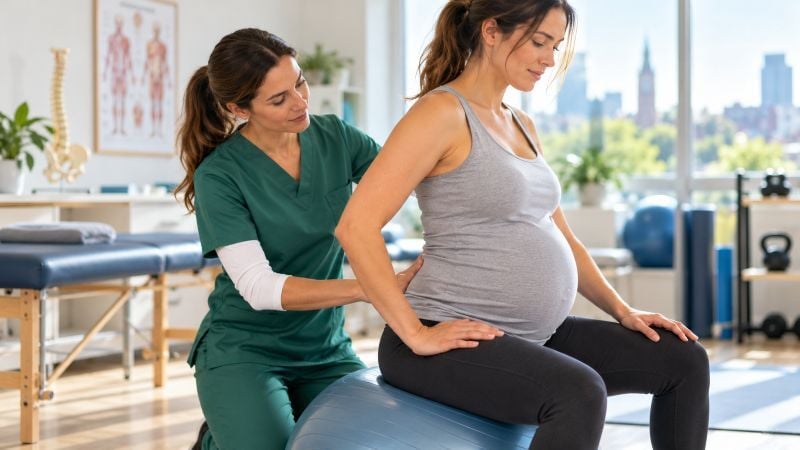
A first appointment combines a conversation about your symptoms and pregnancy with a gentle, pregnancy-adapted physical examination, followed by a personalised plan you can start straight away.
Your assessment
Your physiotherapist will ask how far along you are, about any pregnancy complications, what aggravates and eases your pain, and how it affects sleep, work and caring for others. They will also check for warning signs that need medical review. The examination may include watching how you move, simple pelvic and back tests (often done in sitting, standing or side-lying), and checking muscle strength and nerve function. You stay clothed in comfortable layers — leggings or shorts and a loose top are ideal.
Treatment options
Depending on your assessment, your plan may include:
- Exercise: strengthening for hips, buttocks, back and deep tummy muscles, adapted as your bump grows
- Advice for daily life: getting in and out of bed and the car, managing stairs, dressing while sitting, pacing and workstation set-up
- Hands-on therapy: gentle soft-tissue and joint techniques where appropriate, in comfortable positions
- Support: guidance on a non-rigid pelvic support belt or support garment, and on crutches if walking is very painful
- Pain-management strategies: relaxation and breathing, positioning for sleep, and sensible activity planning
- Birth planning input: noting your comfortable range of leg movement for your midwife
Treatments we do not use in pregnancy
Shockwave therapy is not used during pregnancy. Electrotherapy is generally not applied over the abdomen, pelvis or lower back in pregnancy, although TENS is widely used for labour pain. For context on electrotherapy more broadly, see our guide to electrotherapy safety.
Is physiotherapy safe in pregnancy?
Yes. Physiotherapy is considered safe throughout an uncomplicated pregnancy when it is adapted by a qualified physiotherapist. Adaptations include:
- Positioning. After 19 weeks, POGP advises that lying on your back should be for short periods only. Treatment uses side-lying, supported sitting or kneeling instead.
- Exercise intensity. You should be able to talk while exercising — the “talk test”. Avoid overheating, contact sports and activities with a high risk of falling.
- Pain as a guide. Exercises should not provoke sharp or increasing pain.
- Medical history. Tell your physiotherapist about any complications, such as placenta praevia, pre-eclampsia, a history of preterm labour or a blood clot. Treatment can then be adjusted and coordinated with your midwife or obstetrician. If you have had a recent deep vein thrombosis (DVT), let your physio know before any treatment.
Pregnancy physiotherapy by trimester
The goals of physiotherapy change across pregnancy: building good habits early, managing emerging pain mid-pregnancy, and staying mobile and preparing for birth later on.
| Trimester | What physio focuses on |
|---|---|
| First (weeks 1–12) | Keep or start gentle activity, begin pelvic floor exercises, and get early advice if you have had back pain or PGP before. Previous PGP is the strongest risk factor for it returning. |
| Second (weeks 13–27) | PGP and back pain often appear now, as does round ligament pain. Treatment focuses on strengthening, activity changes and, if helpful, a support belt. From about 19 weeks, exercises move out of lying on your back. |
| Third (weeks 28–40) | Rib pain, carpal tunnel symptoms and sleep discomfort become more common. Treatment prioritises comfortable movement, pacing, sleep positioning with pillows, and planning comfortable labour positions with your midwife. |
The UK Chief Medical Officers’ pregnancy guidance advises aiming for at least 150 minutes of moderate-intensity activity every week and doing muscle-strengthening activities twice a week. If you are new to exercise, start gently and build up gradually. Every activity counts.
Self-help you can start today
Small changes to how you move often make the biggest difference to back and pelvic pain.
- Stay active within comfortable limits: walking, swimming (avoid breaststroke legs if you have PGP), aquanatal, pregnancy Pilates or yoga.
- Keep your knees together when getting in and out of the car or bed, and roll over “in one piece”.
- Sit down to put on trousers, socks and shoes.
- Take stairs one step at a time if they are painful.
- Avoid standing on one leg, wide-legged positions, heavy lifting and carrying a toddler on one hip where you can.
- Sleep on your side with a pillow between your knees and under your bump.
- Do pelvic floor exercises daily. The NHS Squeezy app can remind you.
- For pain relief, the NHS recommends paracetamol as the first choice in pregnancy, at the lowest dose for the shortest time. Check with your midwife, GP or pharmacist before taking any medicine.
After your baby arrives
Most pregnancy-related pelvic pain settles after birth, but some women need ongoing help, and new problems can appear as you lift, feed and carry your baby. NHS Fife and POGP both report that around 94% of women find PGP resolves after labour or within a few weeks of giving birth. A smaller group has longer-lasting symptoms, which is worth having assessed. Keep following your pregnancy advice and exercises for the first few months. Our postnatal recovery guide covers this in detail.
When to see a physiotherapist — and when to get urgent help
See a physiotherapist if pain affects walking, stairs, sleep, work or childcare, or is not settling with self-help. Get urgent medical help, not physiotherapy, for the warning signs below.
Book a physiotherapy assessment if you have:
- pain in the pubic bone, groin, hips, buttocks or lower back that limits daily activities
- difficulty turning in bed, getting out of the car or using stairs
- pain or tingling spreading into a leg, or tingling hands
- pain that you are worried about or that is getting harder to manage
Urgent — contact your midwife, GP or maternity unit (or call 999)
These symptoms need medical, not physiotherapy, assessment:
- vaginal bleeding, or fluid leaking from the vagina
- regular tightenings or period-like cramps before 37 weeks
- severe or constant tummy or back pain
- reduced or changed baby movements
- fever, or pain or burning when passing urine, together with back pain
- pain, swelling or redness in one calf, chest pain or sudden breathlessness
- severe headache, vision problems or sudden swelling of the face, hands or feet
- numbness around the bottom or genitals, new loss of bladder or bowel control, or weakness in the legs
Pregnancy physiotherapy at CK Physio, Hanwell
CK Physio provides pregnancy-adapted musculoskeletal physiotherapy at our clinic at 57 Elthorne Avenue, Hanwell, W7 2JY, and through home visits in selected West London postcodes for people who find travelling difficult in late pregnancy. Our HCPC-registered Chartered Physiotherapists have supported people across Hanwell, Ealing, Acton and West London since 2003.
You can book directly — you do not need a GP referral. If you have private medical insurance, check with your insurer before booking, as some policies treat pregnancy-related conditions differently. We take a whole-person approach, considering sleep, work and daily life alongside your symptoms. For a broader view of the conditions we treat and our physiotherapy services, visit our main pages.
Key terms explained
- Pelvic girdle pain (PGP)
- Pain in one or more joints of the pelvis (pubic symphysis, sacroiliac joints) and the surrounding area, related to pregnancy. Formerly called SPD.
- Lumbopelvic pain
- An umbrella term for low back pain, pelvic girdle pain, or both together.
- Diastasis recti abdominis
- Widening of the midline between the two rectus abdominis muscles during and after pregnancy.
- Pelvic floor dysfunction
- Symptoms such as urinary or faecal leakage, urgency, prolapse or sexual pain caused by pelvic floor muscles not working as they should.
- Round ligament pain
- Short, sharp groin or lower-tummy pain from stretching of the ligaments that support the womb.
- Carpal tunnel syndrome
- Compression of the median nerve at the wrist causing tingling or numbness in the thumb and fingers.
- Non-rigid lumbopelvic belt
- A soft, adjustable support worn around the pelvis, recommended by NICE as an option for pregnancy-related PGP.
- Perinatal pelvic health service
- An NHS service of specialist physiotherapists and midwives that supports pelvic health in pregnancy and for at least a year after birth.
Pregnancy pain: the facts in numbers
- More than 2 in 3 pregnant women have low back pain and almost 1 in 5 have pelvic pain (Cochrane, Liddle & Pennick, 2015; 34 RCTs, 5,121 women).
- PGP affects up to 1 in 5 pregnant women to some degree (NHS).
- An 8–12 week exercise programme reduced the number of women reporting low back and pelvic pain (risk ratio 0.66; moderate-quality evidence; Cochrane 2015).
- Around 94% of women find PGP resolves after labour or within a few weeks of birth (NHS Fife; POGP).
- Carpal tunnel symptoms are reported by 31–62% of pregnant women; nerve tests confirm it in 7–43% (Georgiew et al., Cureus 2025).
- Tummy muscle separation is present in 33.1% at 21 weeks of pregnancy, 60.0% at 6 weeks postnatally and 32.6% at 12 months (Sperstad et al., BJSM 2016).
- Pregnant women are advised to aim for 150 minutes of moderate activity a week, plus muscle strengthening twice a week (UK Chief Medical Officers).
- After 19 weeks, lying on your back should be for short periods only (POGP).
Frequently asked questions
Is physiotherapy safe during pregnancy?
Yes. Physiotherapy is considered safe at every stage of an uncomplicated pregnancy when it is adapted by a qualified physiotherapist. Positions, exercise intensity and hands-on techniques change as your bump grows, and some treatments, such as shockwave therapy, are avoided. Tell your physiotherapist about any complications so care can be coordinated with your midwife.
When should I see a physiotherapist for pregnancy pain?
See a physiotherapist when pain interferes with walking, stairs, sleep, work or caring for children, or is not settling with simple self-help. You do not need to wait until it is severe. NHS guidance says early assessment and treatment may help stop symptoms getting worse. Seek urgent medical help for red-flag symptoms.
Can physiotherapy help pelvic girdle pain?
Yes. NICE antenatal care guideline NG201 advises considering referral to physiotherapy for pregnancy-related pelvic girdle pain, for exercise advice and a non-rigid lumbopelvic belt. Physiotherapy aims to ease pain, improve muscle function and keep you moving, using exercise, daily-activity advice, gentle hands-on therapy where suitable and, if needed, crutches or a belt.
Is PGP the same as SPD?
Largely, yes. Symphysis pubis dysfunction (SPD) is the older name for pain at the front of the pelvis. Pelvic girdle pain (PGP) is now the preferred umbrella term because pain can come from the joint at the front, the sacroiliac joints at the back, or both, and can spread to the hips and thighs.
Will pelvic girdle pain harm my baby?
No. The NHS states that PGP is not harmful to your baby. It can be painful and tiring, and it can affect how easily you move, sleep and work. But it is a musculoskeletal problem, not a sign that something is wrong with the pregnancy itself.
Can I have a vaginal birth with PGP?
Usually, yes. The NHS says most women with PGP can have a vaginal birth. Your midwife can help you plan comfortable positions, such as side-lying or supported kneeling, and record the range of leg movement that stays comfortable in your birth plan. A caesarean is not usually recommended for PGP alone.
Do pregnancy support belts work?
They help some women. NICE suggests considering a non-rigid lumbopelvic belt for pregnancy-related pelvic girdle pain, alongside exercise advice. A belt supports rather than resolves the problem, so it works best as part of a wider plan. A physiotherapist can check the fit and advise how long to wear it.
What exercises are safe for back pain in pregnancy?
Walking, swimming, aquanatal classes, pregnancy Pilates or yoga, and gentle strengthening for the hips, back and tummy are usually suitable. A Cochrane review found low-quality evidence that exercise reduces pregnancy low back pain. Stop any exercise that causes sharp pain, dizziness, bleeding or fluid loss, and seek advice.
Can I lie on my back during physiotherapy when pregnant?
For short periods, yes, but avoid lying flat on your back for long later in pregnancy. POGP advises that after 19 weeks, lying on your back should be for short periods only. Physiotherapists use side-lying, sitting or supported positions instead, and you can always ask to change position.
Do I need a GP referral to see a physio when pregnant?
No. You can book directly with a private Chartered Physiotherapist without a GP referral. For NHS physiotherapy you will usually be referred by your midwife, GP or obstetrician, and some areas offer self-referral through their perinatal pelvic health service. Keep your midwife informed about any treatment.
Can I have shockwave or electrotherapy while pregnant?
Shockwave therapy is not used during pregnancy. Electrotherapy is generally not applied over the abdomen, pelvis or lower back in pregnancy, although TENS is widely used for labour pain. Pregnancy physiotherapy focuses instead on exercise, education, positioning advice and gentle hands-on techniques where appropriate.
Will pelvic girdle pain go away after birth?
For most women, yes. NHS Fife and POGP both report that around 94% of women find PGP resolves after labour or within a few weeks of birth. A smaller group has longer-lasting symptoms, and having PGP makes it more likely to return in a future pregnancy. Persistent postnatal pain is worth having assessed.
Why do my hands tingle in pregnancy?
Tingling, numbness or aching in the thumb and fingers, often worse at night, is commonly carpal tunnel syndrome. Fluid retention presses on the median nerve at the wrist. It is most common in the third trimester and often eases after birth. Night wrist splints and hand exercises can help.
When is back pain in pregnancy an emergency?
Seek same-day medical advice if back pain comes with vaginal bleeding, regular tightenings before 37 weeks, fever, pain passing urine or reduced baby movements. Call 999 if you have numbness around your bottom or genitals, or new loss of bladder or bowel control. These need medical, not physiotherapy, assessment.
Ready to feel more comfortable in your pregnancy?
Our Chartered Physiotherapists in Hanwell will assess you, build a plan that fits your trimester, and help you keep moving.
| Book an appointment | Ask about home visits |
References
All sources verified live as of October 2026. UK guideline bodies and peer-reviewed research only.
- National Institute for Health and Care Excellence. NG201 Antenatal care: recommendations (recommendation 1.4.15 on pelvic girdle pain). NICE, 2021. nice.org.uk/guidance/ng201/chapter/recommendations
- National Institute for Health and Care Excellence. NG210 Pelvic floor dysfunction: prevention and non-surgical management. NICE, 2021. nice.org.uk/guidance/ng210/chapter/recommendations
- NHS. Pelvic pain in pregnancy. NHS.uk, reviewed December 2022. nhs.uk/pregnancy/common-symptoms/pelvic-pain
- Liddle SD, Pennick V. Interventions for preventing and treating low-back and pelvic pain during pregnancy. Cochrane Database of Systematic Reviews, 2015 (34 RCTs, 5,121 women). cochranelibrary.com/cdsr/doi/10.1002/14651858.CD001139.pub4/full · PubMed mirror: pubmed.ncbi.nlm.nih.gov/26422811
- Pelvic, Obstetric and Gynaecological Physiotherapy (POGP). Pregnancy-related pelvic girdle pain and low back pain. thepogp.co.uk/patient_information/womens_health/pregnancy_pgp_lbp.aspx
- Royal College of Obstetricians and Gynaecologists. Pelvic girdle pain and pregnancy. RCOG patient information. rcog.org.uk/for-the-public/browse-our-patient-information/pelvic-girdle-pain-and-pregnancy
- Royal College of Obstetricians and Gynaecologists. Physical activity and pregnancy. RCOG patient information. rcog.org.uk/for-the-public/browse-our-patient-information/physical-activity-and-pregnancy
- NHS England. Perinatal pelvic health services. england.nhs.uk/mat-transformation/perinatal-pelvic-health-services
- Tommy’s. Pelvic pain (SPD or PGP) in pregnancy. tommys.org/pregnancy-information/pregnancy-complications/pelvic-pain-pregnancy
- Sperstad JB, Tennfjord MK, Hilde G, Ellstrøm-Engh M, Bø K. Diastasis recti abdominis during pregnancy and 12 months after childbirth: prevalence, risk factors and report of lumbopelvic pain. British Journal of Sports Medicine, 2016. pubmed.ncbi.nlm.nih.gov/27324871
- Georgiew F, et al. Pregnancy-related carpal tunnel syndrome: a systematic review. Cureus, 2025. pmc.ncbi.nlm.nih.gov/articles/PMC12617996
- UK Chief Medical Officers. Physical activity guidelines (including pregnancy infographic). GOV.UK. gov.uk/government/collections/physical-activity-guidelines
About this article. This guide is educational and does not replace individual advice from your midwife, GP, obstetrician or physiotherapist. If a symptom concerns you, speak to a healthcare professional. We review this page at least once a year, or sooner if NICE, NHS or POGP guidance changes.