
Sports Injury Prevention & Recovery
If you're one of the millions of adults in the UK who exercise regularly, understanding how to prevent injuries—and what to do when they happen—could be the difference between a minor setback and months on the sidelines. According to Sport England's Active Lives Survey, 63.7% of adults now meet the recommended 150 minutes of weekly physical activity, the highest level ever recorded. Yet this participation surge brings injuries at scale: approximately 2 million people attend A&E each year in the UK due to sports-related injuries.
The Complete Guide to Sports Injury Prevention and Recovery for Active Adults
Evidence-based strategies to keep you moving, from prevention through rehabilitation and return to sport
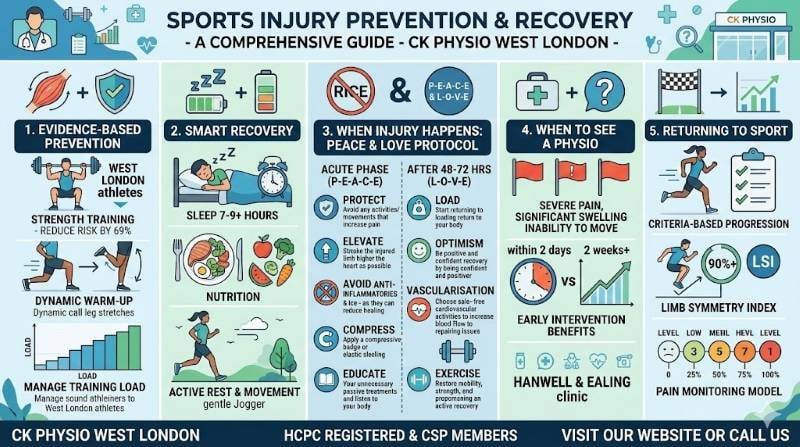
The most effective way to prevent sports injuries is through progressive strength training, which research shows reduces injury risk by approximately 69%. When injuries do occur, the modern PEACE & LOVE protocol has replaced outdated RICE advice, and early physiotherapy intervention—ideally within two days—can halve your recovery time compared to delaying treatment for two weeks or more.
This comprehensive guide, developed by the clinical team at CK Physio in Hanwell, West London, brings together the latest evidence on injury prevention, self-assessment, professional treatment, and safe return to sport. Whether you're a weekend parkrunner, a gym regular, or training for the Ealing Half Marathon, this is your definitive resource for staying active and recovering well.
Understanding the UK Sports Injury Landscape
Sports injuries affect people of all fitness levels, but certain patterns emerge consistently across UK data. The NHS recorded 367,093 sports-related emergency department attendances in England during 2014–2015, representing 1.9% of all emergency attendances. Males are nearly twice as likely to suffer serious sports injury compared to females, and over half of all sports injury A&E visits involve young men aged 10–29.
The "weekend warrior" effect is particularly significant: 55% of all sports injury hospital admissions occur during the two-day weekend versus 45% across the five-day working week. This pattern reflects how many adults compress their physical activity into limited time windows, often without adequate preparation or recovery.
Key UK Injury Statistics
- Running injuries: 37–56% of recreational runners sustain a running-related injury annually, with the knee accounting for 30.7% of all injuries
- Gym injuries: 41% of regular gym-goers report having suffered an injury while working out, with knees (17.3%) and shoulders (11.5%) most commonly affected
- Novice risk: New exercisers have more than double the injury rate of experienced athletes (8.78 vs 4.24 per 1,000 hours of activity)
- Treatment costs: The mean cost of treating a sports injury in the UK is £4,691 per person over 12 months
Perhaps most striking: a UK study of Couch-to-5K participants found that only 27.3% completed the programme, with a 19% injury rate—earning it the nickname "Couch to Ouch to Couch." Previous injury was the strongest predictor of new injury, making proper rehabilitation not just about recovery, but about preventing the next problem.
Evidence-Based Injury Prevention: What Actually Works
The science is clear: strength training is the single most powerful injury prevention tool available to recreational athletes. A landmark 2014 meta-analysis published in the British Journal of Sports Medicine found that strength training reduced sports injuries by approximately 69% and overuse injuries by approximately 50%. No other intervention—not stretching, not equipment, not supplements—comes close to this level of protection.
Warm-Up and Cool-Down: What the Evidence Says
Dynamic warm-ups are firmly the preferred pre-exercise approach. The American College of Sports Medicine recommends a minimum of 7–10 minutes before sport participation, focusing on movements that progressively increase heart rate, body temperature, and joint mobility.
The static stretching picture is more nuanced than commonly presented. Static stretching exceeding 60 seconds before exercise can decrease muscle force and power production. However, short-duration static stretching under 30 seconds, as part of a wider warm-up, is unlikely to impair performance. Static stretching remains appropriate for cool-downs to build long-term flexibility.
Managing Training Load: The Sweet Spot
A 2025 systematic review confirmed that maintaining an acute-to-chronic workload ratio between 0.8 and 1.3 is associated with the lowest injury incidence, while values above 1.5 enter the "danger zone." In practical terms, this means avoiding sudden spikes in training volume or intensity.
The classic "10% rule" (don't increase weekly training volume by more than 10%) lacks strong scientific support as a rigid rule. A study of 532 novice runners found no difference in injury rates between those following the 10% rule and those with more aggressive progression. The consensus among sports medicine experts is that an individualised approach based on your body's adaptation to musculoskeletal stress works better than any fixed formula.
Recovery Science: What Actually Works
Sleep is arguably the single most important recovery modality. The 2021 British Journal of Sports Medicine expert consensus recommends 7–9 hours minimum for the general population and 9+ hours for athletes pursuing peak performance. Sleep deprivation below 7 hours increases injury risk—a well-established finding. Growth hormone secretion concentrates during deep sleep, making it critical for tissue repair.
For nutrition, total daily protein intake matters more than timing. The strict 30-minute post-workout "anabolic window" is overstated; evidence now suggests the window extends to 4–6 hours surrounding training. Target 1.6–2.2g of protein per kilogram of body weight daily, distributed evenly across meals.
A word on ice baths: Cold water immersion at 11–15°C for 10–15 minutes is effective for reducing delayed-onset muscle soreness. However, a 2024 meta-analysis found that post-exercise cold water immersion after resistance training may blunt muscle hypertrophy adaptations by dampening the inflammatory signalling needed for muscle growth. Use ice baths strategically for competition recovery, but consider skipping them after strength training sessions where building muscle is the goal.
When Injuries Happen: The Modern PEACE & LOVE Protocol
RICE is dead—and the new gold standard is PEACE & LOVE. Published in the British Journal of Sports Medicine in 2019 by Dubois and Esculier, this protocol represents a fundamental shift in how we manage soft tissue injuries. Remarkably, a 2025 survey of 200 footballers found that 88% were still unaware of PEACE & LOVE, with nearly 60% continuing to use outdated RICE protocols.
PEACE (Days 1–3 After Injury)
- P – Protect: Limit movement for 1–3 days to minimise bleeding and prevent aggravating the injured tissue. Let pain guide you.
- E – Elevate: Keep the injured limb above heart level when possible to promote fluid drainage and reduce swelling.
- A – Avoid anti-inflammatories and ice: This is the controversial part. Inflammation is a necessary part of healing. Anti-inflammatory medications may delay tissue repair. Ice remains debated for moderate-to-severe injuries.
- C – Compress: Use bandages or taping to limit swelling and provide support.
- E – Educate: Understand your injury and avoid unnecessary treatments. Active approaches generally outperform passive ones.
LOVE (After 48–72 Hours)
- L – Load: Gradually reintroduce movement as pain allows. Appropriate loading promotes tissue repair and remodelling.
- O – Optimism: Maintain a positive mindset. Psychological factors significantly impact recovery outcomes—pessimism and fear can become barriers to healing.
- V – Vascularisation: Pain-free cardiovascular exercise increases blood flow to injured tissues and supports recovery.
- E – Exercise: Customised rehabilitation exercises restore strength, mobility, and proprioception while reducing the risk of re-injury.
When Should You See a Physiotherapist?
The evidence strongly supports early intervention. Research published in JOSPT Open in 2025, analysing data from over 83,000 patients, found that initiating physiotherapy within 0–2 days of injury was associated with a median case duration of just 14 days—compared to 28 days for those delaying 13 or more days. Patients waiting 3–6 weeks were 42% less likely to achieve good pain outcomes. Those waiting more than 6 weeks were 72% less likely to achieve good outcomes.
Signs Your Injury Needs Professional Assessment
While many minor muscle aches resolve with appropriate rest and gentle movement, certain signs indicate that professional assessment is warranted:
- Pain that persists beyond expected healing timelines (most soft tissue injuries should show improvement within 1–2 weeks)
- Pain that worsens rather than improves over several days
- Pain that seems disproportionate to the mechanism of injury
- Inability to perform normal daily activities after 48–72 hours
- Significant swelling, bruising, or deformity
- Clicking, locking, or giving way of a joint
- Any injury that doesn't respond to the PEACE & LOVE protocol within a reasonable timeframe
Need an Assessment?
At CK Physio, you don't need a GP referral to book an appointment. Initial assessments are £85 and include a comprehensive physical examination, diagnosis, and personalised treatment plan. We offer early morning, late evening, and Saturday appointments.
Book Your AssessmentNHS physiotherapy waiting times nationally average 45+ days for routine appointments, with some trusts reaching 4+ months. Private physiotherapy offers immediate access—at CK Physio, most patients can be seen within a week, often within days.
Advanced Treatment Options for Stubborn Injuries
Exercise-based rehabilitation remains the gold standard for most sports injuries. However, for chronic conditions that haven't responded to initial physiotherapy, advanced treatment options can help break the pain cycle and restart the healing process.
Shockwave Therapy
Extracorporeal shockwave therapy (ESWT) has the strongest evidence for plantar fasciitis, with high-quality studies showing large effects on pain and function. NICE is more cautious: because evidence on efficacy is inconsistent, it says ESWT for refractory plantar fasciitis “should only be used with special arrangements for clinical governance, consent and audit or research” (NICE HTG200).
The treatment works by delivering acoustic pulses to injured tissue, stimulating the body's natural healing response, increasing blood flow, and breaking down scar tissue. UK-based NHS trusts report success rates of around 75–80% for appropriate cases. A typical protocol involves 3–4 weekly sessions. At CK Physio, we use focused shockwave technology, which provides greater precision than radial alternatives.
When Shockwave Therapy May Help
- Plantar fasciitis that hasn't responded to 3+ months of conservative treatment
- Achilles tendinopathy, particularly when combined with eccentric loading exercises
- Tennis elbow (lateral epicondylitis) that's become chronic
- Patellar tendinopathy in runners and jumpers
- Greater trochanteric pain syndrome affecting the hip
Shockwave therapy is best positioned as an adjunct to exercise-based rehabilitation—not a replacement for it. The treatment creates an opportunity to engage more effectively with strengthening exercises by reducing pain and kickstarting tissue repair.
Returning Safely to Sport
Current evidence firmly supports criteria-based progression over time-based protocols. Simply waiting a certain number of weeks is not enough—your body needs to demonstrate it's ready to handle the demands of your sport. The modern approach moves through three stages: Return to Participation, Return to Sport, and Return to Performance.
Key Principles for Safe Return
The Limb Symmetry Index (LSI) of 90% or greater is the most commonly used functional milestone—meaning your injured side should demonstrate at least 90% of the strength and function of your uninjured side. For lower limb injuries, this typically includes hop tests, strength assessments, and sport-specific movement patterns.
Critically, 25% of hamstring re-injuries occur in the first week after return to play. For ACL reconstruction, returning before 9 months post-surgery increases second ACL injury risk up to 7-fold. Each additional month of delay up to 9 months reduces re-injury risk by approximately 50%.
The Pain Monitoring Model
For tendinopathies, the pain monitoring model provides useful guidance: continue sport if pain remains 5/10 or below and returns to baseline within 24 hours. If pain exceeds these thresholds, modify activity accordingly. This approach is well-supported by research and allows for active rehabilitation while respecting the body's signals.
Supporting Active Adults Across West London
West London has a remarkably active community. The Ealing Half Marathon—voted the UK's best half marathon three consecutive years—attracts 7,000 runners annually, with the route passing directly through Hanwell. Local parkruns at Gunnersbury, Northala Fields, and Osterley draw hundreds of runners every Saturday morning. The Ealing Eagles Running Club boasts over 700 members and was named Ealing Sports Club of the Year in 2022.
Whether you're training for your first 5K, cycling the Grand Union Canal towpath, playing 5-a-side football, or tackling a CrossFit class at Gymnasium Ealing, understanding how to prevent and manage injuries keeps you doing what you love.
CK Physio has served the Hanwell and Ealing community since 2003. Our Chartered Physiotherapists are HCPC registered and members of the Chartered Society of Physiotherapy. We're registered with major insurers including BUPA and AXA PPP, and conveniently located near Boston Manor and Northfields tube stations.
Frequently Asked Questions
Should I use ice on a sports injury?
The evidence has shifted away from routine icing. The PEACE & LOVE protocol recommends avoiding ice in the acute phase because inflammation is a necessary part of healing. Ice may provide temporary pain relief, but it could delay tissue repair. For significant swelling or pain management, discuss options with your physiotherapist.
How do I know if my pain is DOMS or an actual injury?
Delayed-onset muscle soreness (DOMS) typically peaks 24–72 hours after exercise and affects muscles you've worked, feeling like generalised achiness. An injury often involves sharper, more localised pain that may worsen with specific movements. If pain persists beyond 72 hours, intensifies rather than improves, or limits normal daily activities, seek professional assessment.
Is it worth paying for private physiotherapy?
Research shows that early physiotherapy intervention—ideally within 2 days—can halve recovery time compared to delayed treatment. With NHS waiting times often exceeding 6 weeks, private physiotherapy offers immediate access when timing matters most. Additionally, private clinics like CK Physio offer advanced treatments such as shockwave therapy that may not be available through NHS pathways.
How many physiotherapy sessions will I need?
This varies significantly depending on your condition, its severity, and your goals. After your initial assessment at CK Physio, your physiotherapist will provide a realistic estimate based on your specific situation. Many acute injuries resolve within 3–6 sessions when combined with a home exercise programme. Chronic conditions may require longer-term management.
Do I need a GP referral to see a physiotherapist?
No. You can self-refer directly to private physiotherapy at any time. At CK Physio, simply book online or call to arrange an appointment. If you're using private health insurance, check with your insurer as some policies may require GP referral for coverage.
Is shockwave therapy painful?
Most patients describe shockwave therapy as uncomfortable rather than painful, often comparing it to a tapping or clicking sensation. Your physiotherapist can adjust the intensity to ensure the treatment is tolerable. Some mild tenderness in the treated area for 24–48 hours afterwards is normal. Learn more about what to expect from shockwave therapy.
Taking Control of Your Recovery
The evidence is clear: proactive, exercise-based injury prevention works better than reactive treatment—and strength training offers more protection than any gadget, supplement, or modality. When injuries do occur, the PEACE & LOVE protocol and early physiotherapy intervention give you the best chance of a full, fast recovery.
The early intervention message is both clinically supported and practically important. Patients who wait more than 6 weeks to seek physiotherapy are 72% less likely to achieve good outcomes. With NHS waiting times often exceeding this threshold, early private assessment can make a meaningful difference to your recovery trajectory.
At CK Physio, our goal isn't just to make you pain-free—it's to restore full strength, function, and resilience so you can return to your sport, your fitness routine, and your daily life without fear of re-injury. Book your assessment today and take the first step towards moving well and feeling well.
References
- Dubois B, Esculier JF. Soft-tissue injuries simply need PEACE and LOVE. British Journal of Sports Medicine. 2020;54(2):72-73. bjsm.bmj.com
- Lauersen JB, Bertelsen DM, Andersen LB. The effectiveness of exercise interventions to prevent sports injuries: a systematic review and meta-analysis of randomised controlled trials. British Journal of Sports Medicine. 2014;48(11):871-877. bjsm.bmj.com
- Sport England. Active Lives Adult Survey November 2023-24. Published April 2025. sportengland.org
- NHS Digital. Hospital Episode Statistics: Accident and Emergency Attendances. digital.nhs.uk
- Davies M, et al. Sport-related major trauma incidence in young people and adults in England and Wales. Injury Epidemiology. 2024. biomedcentral.com
- National Institute for Health and Care Excellence (NICE). Extracorporeal shockwave therapy for refractory plantar fasciitis. IPG311. nice.org.uk
- Chartered Society of Physiotherapy. Quality Assurance Standards. csp.org.uk
- Physiopedia. PEACE and LOVE Principle. physio-pedia.com
About CK Physio
CK Physio has provided expert physiotherapy services to the Hanwell and Ealing community since 2003. Our team of Chartered Physiotherapists are registered with the Health and Care Professions Council (HCPC) and members of the Chartered Society of Physiotherapy. We offer comprehensive assessment and treatment for musculoskeletal conditions, sports injuries, and chronic pain, including advanced treatments such as focused shockwave therapy. Learn more about our team. our resource centre exercise and physio




.svg)

.svg)

.svg)