
Shockwave Therapy • Evidence-Based Treatment
If you are reading this, you are probably dealing with shoulder or neck pain that has not settled with rest, painkillers or perhaps a cortisone injection, and you may be wondering whether shockwave therapy could help.
Shockwave Therapy for Shoulder and Neck Pain: What the Research Tells Us
An honest guide from CK Physio to what the evidence does and does not show, and what to expect if you try it.
Shockwave therapy (ESWT) is one option for long-standing shoulder and neck pain that has not settled with exercise-based physiotherapy, but the evidence is more mixed than much of the marketing suggests. A 2020 Cochrane review found very few clinically important benefits for rotator cuff problems overall; some newer reviews are more positive, particularly when shockwave is added to physiotherapy. For calcific shoulder tendinopathy, NICE judges the evidence inadequate and recommends use only in research. At CK Physio we offer focused shockwave as part of a rehabilitation plan, and we will tell you honestly whether it is worth trying for your shoulder or neck.
This article sets out what the research actually shows about shockwave therapy for shoulder and neck conditions — where the evidence is encouraging, where it is weak, and where the major reviews disagree — so you can make an informed decision.
At CK Physio we never use shockwave on its own. It is always part of a physiotherapy treatment plan built around exercise and loading, which is the part of treatment with the strongest evidence behind it. You can read more about how a course works on our page about shockwave therapy in Ealing & Hanwell.
Which shoulder conditions might shockwave help?
The evidence varies a great deal between shoulder conditions, and even the large reviews do not agree.
Rotator cuff tendinopathy and impingement: mixed evidence
A 2024 meta-analysis (Xue et al., BMC Musculoskeletal Disorders) pooled 16 randomised trials involving 1,093 people with rotator cuff tendinopathy and found better pain and shoulder-function scores with shockwave than with control treatments — though the authors themselves describe the evidence as limited.
The 2020 Cochrane review (Surace et al.) looked more widely, at 32 trials and 2,281 people, and was more cautious. Compared with placebo, shockwave improved pain by less than one point on a 0–10 scale at three months, below the level usually considered clinically important. Its authors concluded there were “very few clinically important benefits of shock wave therapy, and uncertainty regarding its safety.”
Our reading is that shockwave may be worth adding for some people with persistent rotator cuff pain, but only alongside a structured exercise programme, and never as a substitute for one.
Calcific tendinopathy: encouraging small studies, but NICE says research only
Some individual studies of calcium deposits in the rotator cuff have reported good results. In one widely cited study (Wang et al., 2003), most of 39 treated shoulders were rated good or excellent at two to three years, and deposits fully dissolved in just over half — but the comparison group contained only six people.
NICE reviewed this use in 2022 (HealthTech guidance HTG645) and judged the evidence on efficacy inadequate, recommending shockwave for calcific shoulder tendinopathy only in the context of research. The Cochrane review also found no difference in results between people with and without calcific deposits. By contrast, the International Society for Medical Shockwave Treatment (ISMST) lists calcifying tendinopathy of the shoulder among its “approved standard indications”. The two bodies disagree, and we will explain both positions before recommending anything.
Frozen shoulder: limited evidence
Shockwave has been studied as an add-on for frozen shoulder (adhesive capsulitis), but the evidence is limited, and it is not something we would expect to be the main part of your treatment.
Evidence Summary by Condition
Can shockwave therapy help with neck pain?
For muscular (myofascial) neck and upper trapezius pain, the evidence is weak. A 2020 meta-analysis of five small trials (Yoo et al., Medicine) found focused shockwave reduced short-term pain more than comparison treatments, but its authors rated the evidence as very low level and called for larger, better-quality trials.
We may discuss shockwave for long-standing muscular neck pain that has not responded to exercise and manual therapy, but we will be clear that the evidence is thin.
Nerve-related neck pain: the evidence for shockwave in cervical radiculopathy (neck pain that spreads down the arm, often with pins and needles or weakness) is very limited. If you have these symptoms we will discuss other approaches and may refer you for further investigation.
Focused or radial shockwave?
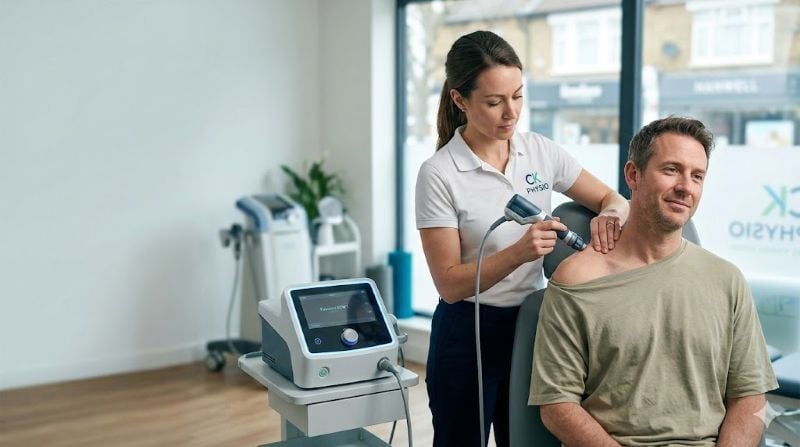
CK Physio offers focused shockwave therapy rather than the radial shockwave most clinics offer. Focused shockwave concentrates its energy at a chosen depth, while radial shockwave spreads energy out from the skin surface and works more superficially.
The direct evidence comparing the two is thin. One small trial (Li et al., 2021) randomised 46 people with non-calcific rotator cuff tendinopathy and found similar results over the first months, but lower pain with focused shockwave at 24 and 48 weeks. ISMST recommends focused, higher-energy treatment for calcifications. That is a reasonable basis for our choice of equipment, but not proof that focused shockwave is always better — our focused vs radial shockwave guide goes into more detail.
Shockwave therapy versus cortisone injections
If you have been offered a cortisone injection, it is natural to ask how the two compare. The clearest data come from tennis elbow rather than the shoulder: a 2024 meta-analysis of six trials (Zhang et al., Orthopaedic Surgery) found steroid injections gave better results at one month, while shockwave did better at three and six months, with similarly low rates of mild side effects.
Whether that pattern applies to shoulder pain has not been established. If you need quick relief, an injection may be reasonable; if you are aiming for longer-term recovery, shockwave combined with physiotherapy may be worth discussing. We will talk it through for your particular problem.
What to expect from shockwave treatment at CK Physio
Your course
Treatment starts with an assessment of up to 45 minutes. A typical course is then three shockwave sessions of around 15–20 minutes each, usually a week or two apart. You will feel a strong tapping or pressure, and we adjust the intensity to what you can tolerate — our guide to whether shockwave therapy is painful covers this in more detail.
Treatment protocols vary widely between clinics and studies. A 2025 international expert consensus (Rhim et al., British Journal of Sports Medicine) set out recommendations on terminology, treatment parameters, contraindications and side effects, while noting that research is limited by this variation in protocols.
Recovery timeline
Where shockwave helps, improvement usually builds gradually over several weeks, with the full effect over a few months, rather than appearing immediately. Not everyone responds; if you do not, we will review the diagnosis and your plan rather than simply adding more sessions.
Side effects and safety
NICE has consistently found no major safety concerns in its reviews of shockwave therapy, while noting that the evidence on how well it works is inconsistent. Common short-lived effects include soreness, redness, minor bruising and swelling.
We will screen for reasons not to treat during your assessment, including pregnancy, cancer or infection in the treatment area, a pacemaker or similar device nearby, significant bleeding disorders, and a recent steroid injection in the same area.
Aftercare
We usually advise avoiding anti-inflammatory painkillers such as ibuprofen around your treatment, because they may dampen the healing response shockwave aims to trigger — although this advice rests mainly on theory rather than trials. Please do not stop any prescribed medication without speaking to your GP.
Treatment costs and insurance
Shockwave therapy at CK Physio is sold as a course rather than a single session. Our bookings page carries the current fees, and our page on shockwave therapy in Ealing & Hanwell explains what a course includes.
We are recognised by BUPA, AXA PPP, WPA, Groupama and Life UK. Shockwave therapy is often covered under physiotherapy benefits, though cover varies by policy. Pre-authorisation is typically required, so please check directly with your insurer before treatment.
To discuss your options or book an initial assessment, call us on 020 8566 4113 or email info@ckphysio.co.uk.
Frequently asked questions
How many shockwave therapy sessions will I need for my shoulder?
A typical course at CK Physio is three sessions, usually a week or two apart. We review your progress as we go and only add sessions if you are responding. Where shockwave helps, improvement usually builds over several weeks rather than straight away.
Is shockwave therapy painful?
Most people find it uncomfortable rather than painful. You will feel a strong tapping or pressure during each 15–20 minute session, and we adjust the intensity to what you can tolerate. The area may be sore for a day or two afterwards.
What is the difference between focused and radial shockwave therapy?
Focused shockwave concentrates its energy at a chosen depth, while radial shockwave spreads energy out from the skin surface and works more superficially. One small trial of 46 people with non-calcific rotator cuff tendinopathy (Li et al., 2021) found similar results over the first months but lower pain with focused shockwave at 24 and 48 weeks. That is a single study rather than a settled finding. CK Physio offers focused shockwave.
Is shockwave therapy better than cortisone injections for shoulder pain?
The best comparison data come from tennis elbow rather than the shoulder. A 2024 meta-analysis of six trials (Zhang et al.) found steroid injections worked better at one month, while shockwave did better at three and six months. Whether the same pattern holds for shoulder pain has not been established, so we will talk through the options for your particular problem.
Can shockwave therapy help with neck pain?
Possibly, for muscular (myofascial) neck and upper trapezius pain, but the evidence is weak. A 2020 meta-analysis of five small trials (Yoo et al.) found only very low-level evidence of short-term pain relief. Shockwave is not a treatment we would rely on for nerve-related neck pain that spreads down the arm.
Is shockwave therapy right for you?
If you have long-standing shoulder or neck pain that has not responded to rest, medication or exercise-based physiotherapy, shockwave may be worth discussing — with realistic expectations about what the evidence shows.
Our chartered physiotherapists are registered with the Health and Care Professions Council and are members of the Chartered Society of Physiotherapy. We will assess your specific condition, explain what the research does and does not show, and recommend the approach most likely to help — which is sometimes shockwave as part of a wider plan, and sometimes something else entirely.
To find out whether shockwave therapy could help, contact us to arrange an initial assessment.
Ready to discuss your treatment options?
Book your initial assessment at CK Physio, Hanwell, or call 020 8566 4113.
Book Now Contact usReferences
- Surace SJ, Deitch J, Johnston RV, Buchbinder R. Shock wave therapy for rotator cuff disease with or without calcification. Cochrane Database of Systematic Reviews. 2020;3:CD008962. PMID: 32128761
- Xue X, Song Q, Yang X, et al. Effect of extracorporeal shockwave therapy for rotator cuff tendinopathy: a systematic review and meta-analysis. BMC Musculoskeletal Disorders. 2024;25:357. doi:10.1186/s12891-024-07445-7
- Wang CJ, Yang KD, Wang FS, Chen HH, Wang JW. Shock wave therapy for calcific tendinitis of the shoulder: a prospective clinical study with two-year follow-up. American Journal of Sports Medicine. 2003;31(3):425–430. PMID: 12750138
- National Institute for Health and Care Excellence (NICE). Extracorporeal shockwave therapy for calcific tendinopathy in the shoulder. HealthTech guidance HTG645 (formerly IPG742). November 2022. nice.org.uk/guidance/htg645
- International Society for Medical Shockwave Treatment (ISMST). Indications. shockwavetherapy.org/indications
- Yoo JI, Oh MK, Chun SW, Lee SU, Lee CH. The effect of focused extracorporeal shock wave therapy on myofascial pain syndrome of trapezius: a systematic review and meta-analysis. Medicine (Baltimore). 2020;99(7):e19085. PMID: 32049811
- Li C, Li Z, Shi L, Wang P, Gao F, Sun W. Effectiveness of focused shockwave therapy versus radial shockwave therapy for noncalcific rotator cuff tendinopathies: a randomized clinical trial. BioMed Research International. 2021;2021:6687094. PMID: 33506031
- Zhang L, Zhang X, Pang L, Wang Z, Jiang J. Extracorporeal shock wave therapy versus local corticosteroid injection for chronic lateral epicondylitis: a systematic review with meta-analysis of randomized controlled trials. Orthopaedic Surgery. 2024;16(11):2598–2607. PMID: 39198038
- Rhim HC, Singh M, Maffulli N, et al. Recommendations for use of extracorporeal shockwave therapy in sports medicine: an international modified Delphi study. British Journal of Sports Medicine. 2025;59(18):1287–1301. PMID: 40032293
CK Physio • Professional, Caring Physiotherapy in Hanwell and Ealing
57 Elthorne Avenue, Hanwell, London W7 2JY • 020 8566 4113 • info@ckphysio.co.uk
Related: shockwave therapy in Ealing & Hanwell • is shockwave therapy painful? • shockwave therapy guide • our electrotherapy services




.svg)

.svg)

.svg)