

Cardiac Rehabilitation · Evidence-Based Care
Published: 14 July 2016 · Last clinically reviewed: 25 August 2026
Important: This article is general information, not medical advice. If you have had a heart attack, always follow guidance from your GP, cardiologist and NHS cardiac-rehabilitation team. Never start, change or stop exercise without their agreement. If you are experiencing chest pain, breathlessness or symptoms of a heart attack now, call 999.
Physiotherapy after a heart attack is the supervised, exercise-based component of cardiac rehabilitation, delivered as part of the NHS pathway defined in NICE guideline NG185. A Chartered Physiotherapist assesses your fitness, safety and confidence, then prescribes progressive exercise, education and self-management support. At CK Physio in Hanwell, we work alongside the NHS — not as a replacement — offering clinic-based and home-visit support across Ealing and West London.
Key takeaways
- NICE recommends that everyone after a heart attack, regardless of age, is offered cardiac rehabilitation with an exercise component.
- Evidence from a 2021 Cochrane review of 85 trials and 23,430 people links exercise-based cardiac rehab with lower cardiovascular mortality, fewer hospital admissions and better quality of life.
- A Chartered Physiotherapist can assess, prescribe and progress your programme, and can support you at home if attending a clinic is difficult.
- Cardiac rehab is a free NHS service by GP or hospital referral; private physiotherapy is best used to complement it (faster access, home visits, ongoing Phase IV maintenance).
What is cardiac rehabilitation, and where does physiotherapy fit in?
Cardiac rehabilitation is a structured, multi-disciplinary programme designed to help you recover after a cardiac event such as a heart attack (myocardial infarction), heart surgery or a diagnosis of coronary heart disease. The British Association for Cardiovascular Prevention and Rehabilitation (BACPR) Standards and Core Components (4th edition, 2023) describe five components: health behaviour change and education, lifestyle risk-factor management (including physical activity), psychosocial health, medical risk management, and long-term strategies.
Physiotherapy is central to the physical-activity component. A Chartered Physiotherapist has the clinical training to assess cardiovascular response to exercise, screen for musculoskeletal or balance issues that could make movement risky, and design a graded programme suited to your history, medication and goals. Chartered Physiotherapists are one of the registered professions recognised by the Chartered Society of Physiotherapy and regulated by the Health and Care Professions Council (HCPC).
What are the four phases of cardiac rehabilitation?
UK cardiac rehabilitation is typically described in four phases, each with a different purpose and level of supervision.
Phase I — In-hospital. Begins on the ward, often within 24–48 hours of your event. Focus on early mobilisation, breathing exercises, education about your condition and discharge planning.
Phase II — Early post-discharge. The first few weeks at home. Gentle activity, monitoring symptoms, and preparing for the structured programme. NICE advises the first cardiac-rehab assessment should be offered within around 10 days of discharge.
Phase III — Structured outpatient programme. Usually 6–12 weeks of supervised exercise plus education sessions on nutrition, stress, medication and lifestyle. This is where physiotherapy-led exercise plays its biggest role.
Phase IV — Long-term maintenance. Ongoing exercise and lifestyle habits, often in community settings or with private support. This is a common point at which people work with a private Chartered Physiotherapist for continuity, reassessment and progression.
How soon after a heart attack can you start exercising?
Gentle, medically supervised movement usually begins in hospital within days. The NHS advises most people can gradually return to everyday activities, walking and eventually more structured exercise once cleared by their cardiac team, with the pace guided by how the recovery is progressing. Detailed timelines vary based on the type of heart attack you had, any procedures (such as angioplasty or bypass surgery), your other health conditions and your baseline fitness.
 The right sequence is: NHS referral first, cardiac-rehab assessment, then supervised exercise. NICE recommends the first assessment appointment be offered within about 10 days of discharge, with the exercise programme starting as soon as it is safe to do so. Read more from the NHS on recovering from a heart attack.
What does the evidence say about exercise after a heart attack?
The evidence base for exercise-based cardiac rehabilitation is one of the strongest in cardiovascular medicine. A 2021 Cochrane systematic review (Dibben et al., CD001800.pub4) pooled data from 85 randomised controlled trials including 23,430 participants with coronary heart disease. It concluded that exercise-based cardiac rehabilitation is associated with reduced cardiovascular mortality, fewer hospital admissions and improved health-related quality of life compared with usual care.
Dibben and colleagues' follow-up meta-analysis (European Heart Journal, 2023) reported approximate risk reductions of around 26% for cardiovascular mortality, around 23% for hospitalisations and around 18% for further myocardial infarction compared with usual care. These are group-level averages from clinical trials, not guarantees for any individual, and they reflect the whole cardiac-rehab package — assessment, medical management, education and behaviour change alongside supervised exercise.
What happens in a physiotherapy-led cardiac session?
A typical assessment with a Chartered Physiotherapist begins with a detailed conversation about your medical history, your event, your medications, your goals and any worries about movement. A physical assessment usually includes:
- Baseline observations — resting heart rate, blood pressure, oxygen saturation and rate of perceived exertion.
- Functional assessment — simple movement, balance and gait screening (particularly important for older adults or after prolonged bed rest).
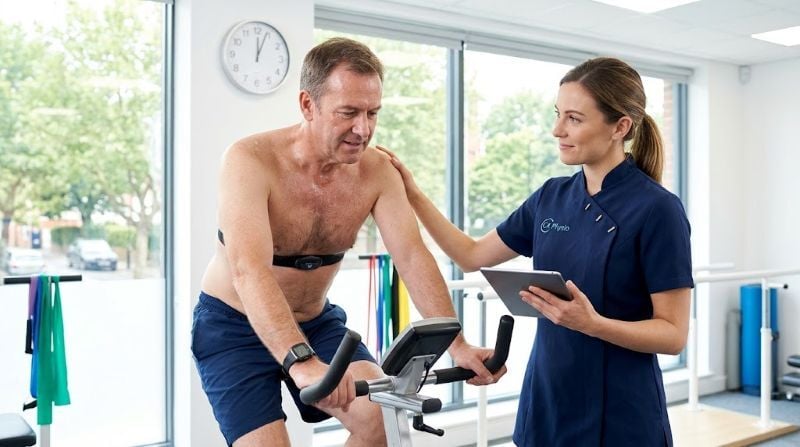
- Sub-maximal exercise test — a graded walking, cycling or stepping test to gauge cardiorespiratory response.
- Musculoskeletal screen — identifying any pain, stiffness or weakness that might affect what exercise looks like for you.
A personalised programme then follows, typically combining aerobic training (brisk walking, cycling, treadmill), light resistance work, flexibility and balance. Your physiotherapist teaches you how to monitor intensity using rate of perceived exertion or a target heart-rate range agreed with your cardiac team, and how to recognise symptoms that mean you should stop and seek advice. Our approach to combining active and supervised exercise is designed to build confidence as well as capacity.
Is it safe to lift weights or try HIIT after a heart attack?
For most stable cardiac patients — once cleared by the cardiac team and after the supervised phase — the answer is yes, in a controlled and progressive way. Resistance training is now a recognised part of cardiac rehabilitation, alongside aerobic work, and can help restore strength, functional capacity and confidence in day-to-day tasks such as carrying shopping or lifting grandchildren.
High-intensity interval training (HIIT) has been studied in stable coronary-heart-disease populations and, when carefully supervised, appears feasible and effective for improving fitness in selected patients. It is not appropriate for everyone, and moderate-intensity continuous training remains the default recommendation in current UK practice. Both approaches should be introduced by a clinician who understands your history, your medication and your symptoms — not self-prescribed from social media.
What about anxiety and confidence around movement?
Fear of movement after a cardiac event is common and completely understandable. Many people feel their body has "let them down" and worry that raising their heart rate could trigger another event. Structured physiotherapy addresses this directly. A supervised setting, clear intensity monitoring, and gradual progression give you the chance to experience your body responding safely to exercise — often the most powerful reassurance there is.
If low mood or anxiety is a bigger part of the picture, cardiac-rehab teams also include or signpost to psychological support. The British Heart Foundation's cardiac-rehabilitation resources are a useful place to start.
NHS cardiac rehab, private physiotherapy or home visits — what should you choose?
Our clear recommendation is: accept and attend NHS cardiac rehabilitation first. It is free, evidence-based, multi-disciplinary and integrated with your ongoing cardiology care. Yet the NHS Long Term Plan set a target of 85% uptake by 2028, and current audit data from the National Audit of Cardiac Rehabilitation (NACR) show that participation is well below that in many parts of England. Barriers include waiting times, work and caring responsibilities, mobility, transport and simply not being offered a suitable programme.
Private physiotherapy has a useful complementary role in three situations in particular:
- Bridging — supervised, graded activity while you wait for your NHS Phase III place.
- Home-based support — particularly for older adults, patients with reduced mobility, or those who cannot easily reach a hospital-based service. A 2023 Cochrane review found home-based and centre-based cardiac rehabilitation produce similar clinical and quality-of-life outcomes.
- Long-term Phase IV maintenance — ongoing exercise progression, reassessment and accountability once your NHS programme has finished.
Digital cardiac-rehabilitation platforms are also evolving quickly: in late 2025, NICE conditionally recommended seven digital cardiac-rehab technologies for a three-year NHS evidence-generation period (see NICE HTE19). Ask your cardiac team whether any of these are available in your area.
How CK Physio supports patients in Ealing, Hanwell and West London
Our clinic in Hanwell (W7) has supported patients across Ealing, Acton, Chiswick, Brentford, Southall and Greenford since 2003. For cardiac-recovery patients, we typically offer:
- One-to-one physiotherapy assessments from Chartered Physiotherapists.
- Home-visit physiotherapy across West London for patients who prefer, or need, to be seen at home.
- Support for older adults recovering after a cardiac event, drawing on our experience with ageing, rehabilitation and physiotherapy and the wider benefits of physiotherapy in senior care.
- Coordination with your GP and cardiology team where you would like us to share progress notes.
You can browse the full range of conditions we treat, learn more about physiotherapy in London, or read about our team.
Considering physiotherapy as part of your cardiac recovery?
Book a one-to-one assessment with a Chartered Physiotherapist at our Hanwell clinic, or request a home visit across Ealing and West London. We work alongside your NHS cardiac-rehab team, not instead of them.
Book an Assessment Contact the ClinicFrequently asked questions
How long does cardiac rehabilitation last?
The structured NHS outpatient phase (Phase III) typically runs for 6 to 12 weeks, with supervised sessions once or twice a week alongside education. Phase IV, the long-term maintenance stage, is designed to continue for life — often with a private physiotherapist, community class or independent programme.
Do I need a GP or cardiologist referral?
For NHS cardiac rehabilitation, yes — you should be automatically referred by the hospital team when you are discharged. For private physiotherapy in the UK you can usually self-refer, but if you have had a recent cardiac event we ask that your GP or cardiologist has confirmed you are medically fit to begin structured exercise before we start.
Can I do cardiac rehabilitation at home?
Yes. A 2023 Cochrane review found home-based cardiac rehabilitation delivers broadly similar clinical and quality-of-life outcomes to hospital-based programmes for stable patients. NHS home-based options exist in many areas, and CK Physio offers home-visit physiotherapy across Ealing and West London for those who prefer or need to be seen at home.
What if I have already missed my NHS cardiac-rehab window?
Talk to your GP — a late referral into an NHS programme is often still possible. If not, a private Chartered Physiotherapist can carry out an assessment, coordinate with your medical team, and put together a supervised programme that mirrors the exercise component of a formal cardiac-rehab pathway.
Is it safe to exercise after a stent, angioplasty or bypass?
For most people, yes — graded, supervised exercise is a core part of recovery after these procedures, and NICE recommends it be offered routinely. Timings and any specific precautions depend on the procedure and your surgeon's advice, so always follow the guidance you have been given by your cardiology team.
Will physiotherapy replace my heart medication?
No. Physiotherapy is a valuable complement to medical care, not a replacement. Any changes to your medication are decisions for your GP, cardiologist or prescribing team — never something to adjust because you feel better after a few weeks of exercise.
Important safety information
This article is general information and is not a substitute for individual medical advice. If you have had a heart attack or other cardiac event, follow the guidance of your GP, cardiologist and NHS cardiac-rehabilitation team when deciding on any activity or exercise programme.
Stop exercising and seek medical advice if you develop chest pain, unusual breathlessness, dizziness, palpitations or any other symptom that worries you. If symptoms suggest a heart attack — chest pain, pain spreading to the jaw or arms, sudden shortness of breath, sweating — call 999 immediately.
References
- National Institute for Health and Care Excellence. Acute coronary syndromes (NG185). Recommendations — Cardiac rehabilitation. nice.org.uk/guidance/ng185
- Dibben G, Faulkner J, Oldridge N, et al. Exercise-based cardiac rehabilitation for coronary heart disease. Cochrane Database of Systematic Reviews, 2021; CD001800.pub4. Cochrane review summary · PubMed
- NHS. Recovery — Heart attack. nhs.uk/conditions/heart-attack/recovery
- British Heart Foundation. Cardiac rehabilitation. bhf.org.uk
- British Heart Foundation. UK Heart and Circulatory Disease Statistics. bhf.org.uk/heart-statistics
- British Association for Cardiovascular Prevention and Rehabilitation (BACPR). Research and Resources — Standards and Core Components (4th edition, 2023). bacpr.org/research-and-resources
- National Audit of Cardiac Rehabilitation (NACR). Quality and Outcomes Reports. nacr.org.uk
- National Institute for Health and Care Excellence. Digital technologies for delivering specialist weight-management services and cardiac rehabilitation (HTE19). nice.org.uk/guidance/hte19
- NHS England. The NHS Long Term Plan. england.nhs.uk/long-term-plan
- Health and Care Professions Council. Check the register. hcpc-uk.org/check-the-register




.svg)

.svg)

.svg)