
Written by Bryan Kelly MCSP, Chartered Physiotherapist
Last reviewed: 19 Oct 2026 · Next review due: October 2027
Most knee injuries — sprains, meniscus tears, patellofemoral (runner’s) knee, tendon problems and osteoarthritis — are managed first with a structured, progressive exercise programme guided by a Chartered Physiotherapist. Many people recover without surgery. In the KANON trial, for example, around half of young adults with an acute anterior cruciate ligament (ACL) tear who started with rehabilitation had still not had reconstruction five years later. Some injuries do need imaging or a surgeon, so seek urgent advice if your knee locks, gives way, swells immediately after a twist, or cannot take weight.
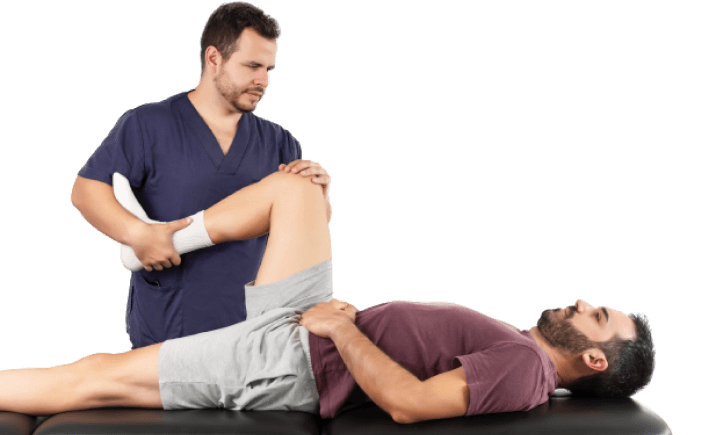
What is knee injury physiotherapy? It is the assessment, diagnosis and treatment of knee problems by an HCPC-registered physiotherapist. Treatment centres on progressive exercise, education and load management, with hands-on techniques and other modalities used as supportive add-ons where the evidence supports them.
Not sure what is going on with your knee? Our Hanwell team can help you work it out.
Book a Knee Assessment Is it serious? Knee red flags and when to seek urgent care
Most knee problems settle with time, exercise and sensible load management. A small number need urgent assessment. Taking a few seconds to rule out the serious causes first is good practice, and it protects you from heading into a routine physio appointment when A&E or a GP review would be the safer first step.
Seek urgent advice (NHS 111, an urgent treatment centre or A&E) if your knee:
- Is very painful and you cannot move it or put any weight on it
- Is badly swollen or has changed shape
- Locks, gives way or clicks painfully with each step
- Swelled up straight after a twisting injury (within an hour or so)
- Feels hot and looks red, especially if you also feel feverish or unwell
These criteria mirror the NHS and NHS Inform guidance for knee pain, and they capture most of the injuries that need imaging, an orthopaedic opinion or urgent treatment on the day.1,2
After knee surgery or a period of immobilisation? New calf pain, swelling or breathlessness can be signs of deep vein thrombosis (DVT) and need same-day medical review. If in doubt, call 111 or go to A&E. Our guide to DVT warning signs walks through this in more detail.
When physiotherapy is the right first stop
If none of the red-flag features apply, physiotherapy is usually a sensible first port of call. NHS Inform notes that most new episodes of knee pain “should begin to settle within 6 weeks” with sensible self-care; book an assessment sooner if you are not making steady progress, if symptoms are stopping you doing the things that matter to you, or if you want a clear diagnosis and plan from the start.2
Which knee injury might you have? A “where does it hurt?” guide
The NHS is clear that you should not try to self-diagnose, but knowing which structures sit where can help you describe your symptoms to a clinician and understand what questions you are likely to be asked.1 The table below pulls together the common causes of knee pain by location.
| Where it hurts | Common causes | Tell-tale signs |
|---|---|---|
| Front of the knee | Patellofemoral pain (runner’s knee); patellar tendinopathy (jumper’s knee); prepatellar bursitis | Worse on stairs, squatting, after long sitting (“theatre sign”); loading hurts the knee cap area |
| Inside of the knee | Medial collateral ligament (MCL) sprain; medial meniscus tear; medial compartment knee osteoarthritis; pes anserine bursitis | Pain on the inner joint line, often after a twist or hit from the outside; stiffness in the morning |
| Outside of the knee | Iliotibial band syndrome (common in runners and cyclists); lateral collateral ligament (LCL) sprain; lateral meniscus tear | Nagging ache along the outer thigh/knee during running or cycling; worse downhill |
| Deep in the knee or feels unstable | Anterior cruciate ligament (ACL) tear; meniscal tear with catching or locking; posterior cruciate ligament injury | A “pop” at the time of injury; rapid swelling within an hour; knee gives way on turning or pivoting |
| Gradual ache, stiff after rest | Knee osteoarthritis | Short-lived morning stiffness, pain with activity, better with movement; often both knees |
If several of these descriptions sound like you, that is not unusual — two or three conditions often sit together, particularly in sports injuries and in longer-standing problems. A proper examination sorts out which is driving the pain and which is sitting quietly in the background.
How physiotherapy treats knee injuries: what the evidence actually supports
Knee physiotherapy has moved on considerably over the last decade. The honest answer about what works is that one thing — progressive, individualised exercise — carries most of the benefit, and almost everything else is either a supportive add-on or something your musculoskeletal physiotherapist might use selectively.
Exercise therapy is the foundation
For knee osteoarthritis, NICE guideline NG226 is unambiguous: offer therapeutic exercise tailored to the person’s needs as a core treatment, alongside education and — where relevant — weight management.3 A Cochrane update of 54 trials found that exercise reduced pain by around 12 points out of 100 and improved function by about 10 points out of 100 immediately after treatment.4 For patellofemoral pain, the 2024 British Journal of Sports Medicine best-practice guide reaches a similar conclusion: exercise therapy with education is the primary intervention.
Education and load management
A big part of what you pay for in a good knee rehab programme is help understanding what you can and cannot do day-to-day, and how to pace activity so you make steady progress without flaring symptoms. NICE specifically warns clinicians to tell patients that pain may increase slightly when starting an exercise programme — that is normal, not a sign of damage.3
Hands-on treatment as a supplement
NICE NG226 recommends manual therapy only alongside exercise for hip and knee osteoarthritis, not as a stand-alone treatment.3 That is how we use it at CK Physio: targeted joint mobilisation and soft-tissue work alongside your home programme, when it is likely to make the next session or the next week of training more comfortable and productive.
Shockwave therapy: where it fits and where it does not
For patellar tendinopathy (jumper’s knee), a 2023 living network meta-analysis by Challoumas and colleagues found that adding shockwave therapy did not improve short-term outcomes beyond a well-designed loading programme, and recommended a minimum 12 weeks of progressive loading first.5 For other knee tendon problems the picture is similar: shockwave can have a role as a case-by-case option for symptoms that persist after a structured loading block, not as a first step. Read more about the difference between focused and radial shockwave or how it is used across our shockwave service.
Electrotherapy (TENS, interferential, ultrasound)
Electrotherapy offers modest, short-term pain relief at best; TENS has the strongest evidence base, mainly in knee osteoarthritis. NICE NG226 does not routinely recommend electrotherapy for osteoarthritis, and we are honest with patients about that when they ask whether a machine will do the job on its own.3 If you want the full picture, see our guides on electrotherapy for muscles and joints and interferential therapy.
Taping, braces and insoles
These help some people get through a specific task — a run, a tennis match, a long day on their feet — or a specific stage of rehab. NICE guidance recommends offering supports and braces where there is joint instability or abnormal loading, rather than for everyone.3 We will usually trial these alongside your exercise programme and reassess within a few weeks.
What we do not routinely recommend
NICE NG226 advises against acupuncture or dry needling for osteoarthritis, and clinical guidelines for patellofemoral pain conclude that passive treatments such as therapeutic ultrasound and electrical stimulation are not useful on their own.3 If a treatment is not helpful, our job is to tell you that honestly rather than keep adding it to your appointments.
Physiotherapy or surgery? What the research says for ACL and meniscus injuries
This is one of the most-asked questions in a knee clinic, and the honest answer is: it depends on the injury, your symptoms and your goals. Here is what the strongest UK-relevant research tells us.
ACL tears: rehabilitation-first works for many, but not all
The landmark KANON trial (Frobell and colleagues, New England Journal of Medicine 2010, with five-year follow-up in the BMJ in 2013) randomised young, active adults with an acute ACL tear to either early reconstruction or rehabilitation with the option of delayed reconstruction. Rehabilitation-first was not inferior to early surgery on patient-reported outcomes.6,7 By five years, around half of the rehab-first group had never had a reconstruction, and around half had chosen delayed surgery when instability became a problem.
The ACL SNNAP trial, published in the Lancet in 2022, looked at a different question: adults with a non-acute ACL injury and ongoing instability. Here, surgical reconstruction was clinically superior to rehabilitation alone and more cost-effective on NHS economic analysis.8 Taken together, these trials give us a clear decision framework: for an acute ACL injury, structured rehabilitation is a reasonable starting point and some people never need surgery; if instability persists despite good rehab, reconstruction is the better choice. A physiotherapist can guide you through either route and refer you if an orthopaedic opinion becomes the right next step.
Degenerative meniscus tears and “wear-and-tear” knees
The BMJ 2017 Rapid Recommendation on arthroscopic surgery is one of the clearest statements in modern orthopaedic practice: a strong recommendation against arthroscopy for nearly all patients with degenerative knee disease, including degenerative meniscal tears.9 Exercise therapy is the first-line approach. The main exceptions are a truly locked knee that cannot be straightened and some acute traumatic meniscal tears in younger people — both warrant orthopaedic review.
Knee osteoarthritis and joint replacement
NICE recommends considering referral for joint replacement when symptoms substantially affect quality of life and non-surgical care — exercise, weight management if relevant, and pain relief — has been tried and is either ineffective or unsuitable.3 Physiotherapy has a role on both sides of surgery: a pre-habilitation programme before a planned replacement, and a progressive post-operative programme afterwards.
Do I need an MRI?
Usually not. NICE is clear that knee osteoarthritis is diagnosed clinically without the need for imaging, and most soft-tissue problems are identified by a careful examination.3 MRI is helpful when the result would change your management — for example, a suspected ACL rupture in an athlete, a locked knee, or a knee that is not responding to a well-structured rehab programme. Your physiotherapist will arrange or recommend imaging where it is clinically useful.
How long does knee injury recovery take? Typical timelines
Recovery timelines are the single most searched question about knee injuries. The ranges below are typical in the clinical literature and in our day-to-day experience in Hanwell. They are typical ranges rather than promises, and your own recovery is shaped by the specifics of your injury, your age, your general health and how consistently you can follow your programme.
| Injury | Return to daily activity | Return to sport | Notes |
|---|---|---|---|
| Grade I–II MCL sprain | 2–4 weeks | 4–8 weeks | Typical clinical experience; higher grades need longer |
| Patellofemoral (runner’s) knee | Steady improvement over 6–12 weeks | Variable; graded return within the same window for most | Longer symptom duration before starting rehab predicts a slower response |
| Patellar tendinopathy (jumper’s knee) | Function usually improves within a few weeks | Minimum 12-week progressive loading block | Based on Challoumas 2023 recommendations5 |
| Degenerative meniscus tear (exercise-managed) | 6–8 weeks for most symptoms to settle | 8–12 weeks graded return | Typical clinical experience in line with BMJ 2017 guidance9 |
| ACL injury (non-operative) | 3–6 months | No earlier than 9 months, with pass criteria | Grindem 2016: re-injury risk falls with each month delayed to 9 months10 |
| ACL reconstruction (post-operative) | 6–12 weeks for walking tasks | No earlier than 9 months for pivoting sport | Return-to-sport testing required10 |
| Knee osteoarthritis | Benefits of exercise usually within weeks | Ongoing self-management | Cochrane: ~12 point improvement in function (0–100)4 |
Ranges are typical and will vary between individuals. Your physiotherapist will give you a personalised estimate after assessment.
What speeds up or slows down recovery
The factors that matter most are the ones you can shape day to day: how long symptoms have been going on before you start rehab, how consistently you can do your home programme, sleep, overall training load, and your confidence in moving the knee. Fear of movement — sensibly — drives many people to protect the knee more than they need to, which slows progress rather than quickens it.
Return-to-sport testing
For higher-demand sports, “ready to return” means more than “the pain is gone”. Objective testing — quadriceps strength symmetry of at least 90 per cent, a battery of single-leg hop tests, and psychological readiness measures — is standard practice after ACL reconstruction and increasingly common for serious meniscus and patellar tendon problems too.10
Your knee rehabilitation journey at CK Physio: what to expect
Your first appointment
A first knee appointment at our Hanwell clinic typically runs through six steps:
- History: how the injury started, what makes it better or worse, your goals and any red flags
- Movement and strength tests: range of motion, single-leg control, strength and balance
- Special tests: targeted tests for ligament, meniscus and patellofemoral problems
- Working diagnosis: a clear explanation in plain English of what we think is going on
- Plan: an outline of how many sessions you are likely to need and a realistic timeframe
- First exercises: a short, tailored programme to start that day
Session length and current fees are listed on our bookings page, and we also offer home visits across West London where that is more practical than coming to the clinic.
Phase-based rehabilitation
We progress people through four broad phases, driven by what the knee can do rather than by set weeks on a calendar:
- Settle: calm symptoms, restore walking, protect the recovering tissues
- Restore movement: full range of motion, basic strength, daily tasks without compensations
- Rebuild strength: structured progressive loading of the quadriceps, hamstrings, calves and hips
- Return to activity: sport-specific drills, impact work, reactive and change-of-direction training
Working with your GP, consultant and insurer
If an orthopaedic opinion, GP review or a scan would be the right next step, we will say so and write to your GP or consultant with a clear summary. We are recognised by major UK private medical insurers — please check the latest list on our bookings page — and we also see self-pay patients.
Your first appointment includes a full assessment, a clear explanation of what is going on, and your first exercises to take away.
Book Online Call 020 8566 4113Reducing the risk of knee injury (and re-injury)
Nothing stops injuries altogether, but three habits make a real difference to how often knees give trouble, and how quickly they recover when they do:
- Structured warm-ups. Programmes like FIFA 11+ have good evidence in football and extend naturally to other field and court sports.
- Progressive strength training. Twice-weekly lower-limb strength sessions are the single most useful habit for most athletes and active adults.
- Sensible load progression. For runners, that is a steady weekly mileage build; for cyclists, a good bike fit and gradual time-in-the-saddle; for triathletes, careful management of the overall training load across all three disciplines.
If you have had one serious knee injury before — particularly an ACL reconstruction — staying on an ongoing strength programme is one of the best investments you can make in the long-term health of the knee.
Knee physiotherapy in Hanwell, Ealing and West London
CK Physio has been treating knee injuries in West London since 2003. Our clinic is at 57 Elthorne Avenue, Hanwell, London W7 2JY, five minutes from Hanwell station and easily reached from Ealing, West Ealing, Northfields, Acton, Chiswick, Greenford, Southall and Brentford.
The team is made up of HCPC-registered Chartered Physiotherapists with specific experience in knee rehabilitation across the full range covered on this page — from day-of-injury sports presentations to long-standing osteoarthritis, and from post-surgical rehabilitation to desk-worker knee pain. You can learn more about the clinic on our Hanwell physiotherapy clinic page, see the full list of conditions we treat, or get in touch via our contact page.
Frequently asked questions
How long does it take to recover from a knee injury with physiotherapy?
It depends on the injury. Many sprains and runner’s knee cases settle over weeks to a few months with the right programme. Anterior cruciate ligament injuries take many months, and returning to pivoting sport is not advised before nine months after reconstruction.10 Your physiotherapist will give you a tailored estimate after assessment.
Can a torn ACL recover without surgery?
The ligament itself usually does not reattach, but many people regain a stable, functional knee with structured rehabilitation. In the KANON trial, around half of young adults with an acute ACL tear who started with rehabilitation had still not needed reconstruction five years later.7 If instability persists, reconstruction is the better choice.8
Should I have surgery for a torn meniscus?
For degenerative meniscus tears, international guidelines strongly recommend exercise therapy over arthroscopic surgery for nearly all patients.9 A truly locked knee or an acute traumatic tear in a younger person still warrants orthopaedic review.
Do I need a GP referral to see a physio for knee pain?
Not for self-pay — you can book directly. Insurers may require a GP referral or a pre-authorisation code. On the NHS, routes include your GP, a First Contact Practitioner or self-referral, depending on your area.1
Do I need an MRI before physiotherapy?
Usually not. NICE recommends diagnosing knee osteoarthritis clinically without imaging, and most other knee problems are identified by examination.3 Imaging is used when the result would change your management.
Is it okay to walk or exercise with knee pain?
Usually yes, within tolerable limits. NICE notes that pain may increase slightly when starting an exercise programme — that is normal and does not mean damage.3 Stop and seek advice if the knee swells, locks or gives way.
Does shockwave therapy work for knee pain?
The evidence is mixed. For patellar tendinopathy, a 2023 review found that shockwave added no short-term benefit to a structured loading programme, and recommended a minimum 12 weeks of loading first.5 It may be discussed as a case-by-case option for symptoms that persist afterwards.
What happens at a knee physiotherapy assessment?
A thorough history, a movement and strength examination, specific tests for ligament and meniscus problems, a working diagnosis explained in plain English, a tailored plan, and your first exercises. Session length and fees are listed on our bookings page. If you would like a walk-through, see our guide on what to expect at a knee appointment.
How much does knee physiotherapy cost in West London?
Our current fees for an initial assessment and follow-up appointments are published on our bookings page, and we are recognised by the major UK private medical insurers — please check the latest list before you book.
Can physiotherapy help knee arthritis?
Yes. The NICE core treatments for knee osteoarthritis are therapeutic exercise, education and, where relevant, weight management.3 Physiotherapy can reduce pain and improve function; it does not reverse joint changes. Our knee osteoarthritis guide walks through the full approach.
References
- NHS. Knee pain. https://www.nhs.uk/symptoms/knee-pain/
- NHS Inform. Knee problems. nhsinform.scot — knee problems
- National Institute for Health and Care Excellence. Osteoarthritis in over 16s: diagnosis and management (NG226), Recommendations. nice.org.uk/guidance/ng226
- Fransen M, McConnell S, Harmer AR, et al. Exercise for osteoarthritis of the knee. Cochrane Database of Systematic Reviews (and 2024 update). pmc.ncbi.nlm.nih.gov/articles/PMC11613324
- Challoumas D, et al. Effectiveness of exercise treatments with or without adjuncts for common lower limb tendinopathies: a living systematic review and network meta-analysis. Sports Medicine – Open, 2023. pmc.ncbi.nlm.nih.gov/articles/PMC10409676
- Frobell RB, Roos EM, Roos HP, et al. A randomized trial of treatment for acute anterior cruciate ligament tears (KANON). N Engl J Med 2010. pubmed.ncbi.nlm.nih.gov/20660401
- Frobell RB, Roos HP, Roos EM, et al. Treatment for acute anterior cruciate ligament tear: five-year outcome of randomised trial. BMJ 2013;346:f232. pubmed.ncbi.nlm.nih.gov/23349407
- Beard DJ, Davies L, Cook JA, et al. Rehabilitation versus surgical reconstruction for non-acute anterior cruciate ligament injury (ACL SNNAP): a pragmatic randomised controlled trial. Lancet 2022. pubmed.ncbi.nlm.nih.gov/36030807
- Siemieniuk RAC, Harris IA, Agoritsas T, et al. Arthroscopic surgery for degenerative knee arthritis and meniscal tears: a clinical practice guideline. BMJ 2017;357:j1982 (Rapid Recommendation). pmc.ncbi.nlm.nih.gov/articles/PMC5426368
- Grindem H, Snyder-Mackler L, Moksnes H, Engebretsen L, Risberg MA. Simple decision rules can reduce reinjury risk by 84% after ACL reconstruction: the Delaware-Oslo ACL cohort study. Br J Sports Med 2016;50(13):804–808. pubmed.ncbi.nlm.nih.gov/27162233
Still have questions about your knee?
Speak to our team, and if physiotherapy is not the right next step, we will tell you who to see.
About the author. Bryan Kelly, MCSP is a Chartered Physiotherapist and member of the Chartered Society of Physiotherapy, registered with the Health and Care Professions Council. He is the clinic founder and principal clinician at CK Physio since 2003.
This article provides general information about physiotherapy for knee injuries. It is not a substitute for individual assessment and advice from an HCPC-registered healthcare professional. If you are worried about your knee or you have any of the red-flag symptoms listed above, please contact NHS 111 or your GP.