
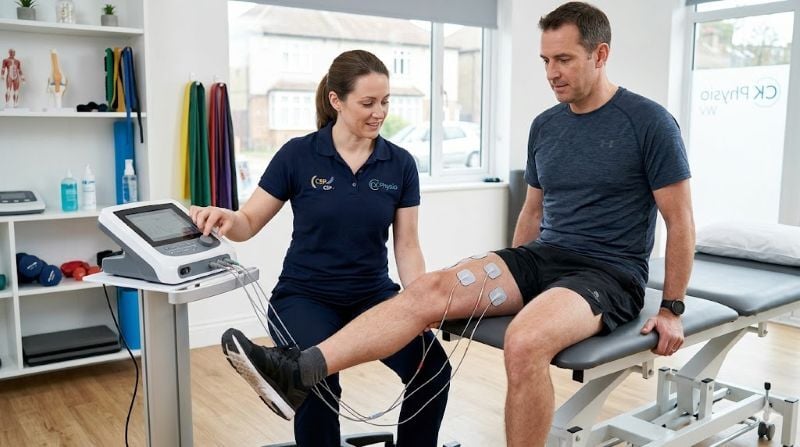

Electrotherapy · Patient guide
This guide explains how electrotherapy actually fits into modern physiotherapy, what today's clinical evidence supports, and what to expect when these treatments are combined in your care at our West London clinic.
Electrotherapy and physiotherapy treatments: how they work together
Electrotherapy is a treatment modality used within physiotherapy — not a separate or alternative therapy. At CK Physio in Hanwell, West London, our Chartered Physiotherapists use modalities such as TENS, neuromuscular electrical stimulation, and interferential therapy as part of a wider, evidence-based plan that also includes manual therapy, prescribed exercise, and patient education.
Key takeaway
Electrotherapy is one tool inside a physiotherapist's toolkit, not a treatment you choose instead of physiotherapy. Used selectively and alongside active rehabilitation, modalities like TENS and neuromuscular electrical stimulation can support pain modulation and muscle re-education. The strongest current evidence, however, backs active interventions — exercise, education, and manual therapy — as the foundation of recovery.
How electrotherapy fits within a physiotherapy treatment plan
Physiotherapy is a regulated health profession in the UK, delivered by clinicians registered with the Health and Care Professions Council (HCPC) and typically members of the Chartered Society of Physiotherapy (CSP). A physiotherapy assessment looks at the whole person — your history, movement, strength, lifestyle, and goals — before recommending any specific treatment.
Electrotherapy is one of many treatment options a Chartered Physiotherapist may select after that assessment. Others include manual therapy, joint mobilisation, prescribed exercise, postural advice, taping, acupuncture, and education. At CK Physio, electrotherapy is never used as a standalone treatment. It is always one component of a tailored plan, chosen only when there is a clear clinical rationale for it.
This matters because asking "should I have electrotherapy or physiotherapy?" is a little like asking "should I have an X-ray or see a doctor?" The modality sits inside the consultation — not in competition with it.
The main electrotherapy modalities used in modern physiotherapy
The umbrella term "electrotherapy" covers several distinct techniques. Each targets a different physiological mechanism, and each has its own evidence base. The five forms most commonly used in UK physiotherapy clinics today are summarised below.
| Modality | How it works | Typical clinical use |
|---|---|---|
| TENS Transcutaneous Electrical Nerve Stimulation |
Low-voltage current delivered via skin electrodes; modulates pain signalling. | Short-term pain management; patient-led self-treatment between sessions. |
| NMES Neuromuscular Electrical Stimulation |
Stronger current that produces a visible muscle contraction. | Muscle re-education after injury, surgery, or prolonged disuse. |
| Interferential IFT |
Crossed medium-frequency currents reach deeper tissues than TENS. | Deeper musculoskeletal pain and localised swelling. |
| Therapeutic ultrasound | High-frequency sound waves transmitted into tissue. | Soft-tissue heating; use case narrowing as evidence evolves. |
| Shockwave ESWT |
Focused acoustic pressure waves stimulate tissue healing. | Persistent tendinopathies — Achilles, plantar fascia, tennis elbow. |
Source: Physiopedia — Current Concepts in Electrotherapy; CK Physio clinical practice, West London, 2026.
For a deeper look at how each technique works, see our companion guide on what electrotherapy treatment is and how it works. We treat shockwave therapy as a related but distinct service because of its specialised role in treating stubborn tendon conditions.
What today's evidence really says about electrotherapy
An honest answer is more useful than a confident one. Over the past five years the evidence base for several electrotherapy modalities has tightened considerably, and the major UK clinical guidelines have shifted with it. We think it is important you know that, because the right treatment plan depends on it.
Where the evidence is weaker than once assumed
- Chronic primary pain. NICE guideline NG193 (2021) reviewed electrical physical modalities — including TENS, ultrasound, and interferential therapy — and did not recommend them for the routine management of chronic primary pain in adults, citing low-quality evidence.
- Osteoarthritis. NICE guideline NG226 (2022) does not routinely recommend electrotherapy for managing osteoarthritis pain.
- TENS overall. A Cochrane overview of TENS reviews concluded that, due to very low-quality evidence, it is not possible to state with confidence whether TENS reliably reduces chronic pain compared with sham or no treatment.
Where the evidence is more supportive
- Muscle re-education with NMES. Neuromuscular electrical stimulation has reasonable evidence for restoring muscle activation after knee surgery, prolonged immobilisation, or certain neurological conditions.
- Pelvic-floor rehabilitation. Electrical stimulation has supportive evidence as an adjunct for specific pelvic-floor dysfunctions when it is integrated with active exercise. CK Physio doesn't offer pelvic health physiotherapy; the NHS says “A GP can refer you to your local continence service and in some cases you may be able to refer yourself” (NHS).
- Shockwave for tendinopathies. Extracorporeal shockwave therapy has stronger evidence for persistent tendon conditions than most other electrotherapy modalities — which is why we treat it as its own specialism at CK Physio.
This is exactly why, at our West London clinic, electrotherapy is offered as an adjunct rather than a centrepiece. Your Chartered Physiotherapist will talk you through whether a particular modality is likely to help your specific condition before recommending it. For a fuller picture of the trade-offs, read our review of the advantages and risks of using electrotherapy.
Unsure whether electrotherapy is appropriate for your condition?
Book an assessment with a Chartered Physiotherapist at our Hanwell clinic — we only recommend it when the clinical picture warrants it.
When electrotherapy may help — and when it may not
The decision to include electrotherapy in a plan is always made by the Chartered Physiotherapist treating you, based on your diagnosis, history, and treatment goals. The patterns below reflect current clinical practice.
Situations where electrotherapy may be considered
- Short-term pain relief that helps you engage with active rehabilitation
- Muscle activation problems after surgery or prolonged immobilisation
- Persistent tendinopathies that have not responded to a loading programme (often a role for shockwave)
- Specific post-natal musculoskeletal presentations as part of a broader programme
- Selected post-stroke or neurological cases where motor relearning is the goal
Situations where electrotherapy is usually not the right answer
Please be aware
- As a standalone treatment, without active rehabilitation alongside it
- When NICE guidance specifically advises against it for your condition
- Over a cardiac pacemaker, an active implant, broken skin, or a recent thrombosis — these are absolute contraindications
- During pregnancy, without specific obstetric clearance
- As a way to avoid addressing the underlying cause — strength, control, load tolerance, or behaviour
For TENS-specific scenarios, our guide to using TENS in physiotherapy treatment covers the common pain conditions where it tends to be considered. For more complex or uncertain presentations, a full assessment is always the safest first step — see the conditions we treat at our Hanwell clinic.
What to expect at a CK Physio appointment in West London
At our Hanwell clinic (W7), which serves Hanwell, Ealing, and the surrounding West London neighbourhoods, an initial appointment generally follows a familiar pattern.
- Subjective assessment. Your physiotherapist asks about your symptoms, medical history, lifestyle, work, and goals. This typically takes 15 to 20 minutes.
- Physical assessment. Movement, strength, joint range, neurological screening, and specific tests for your presentation.
- Working diagnosis and plan. Your physiotherapist explains what they think is going on, what the evidence supports, and what the recommended plan looks like — including whether any electrotherapy modality is appropriate.
- Initial treatment and home programme. Most first sessions include hands-on treatment and a tailored exercise programme you can do at home.
- Review. Follow-up appointments are scheduled around your specific condition — typically weekly or fortnightly to begin with, and less frequently as you progress.
If electrotherapy is part of your plan, your physiotherapist will talk you through the rationale, what the sensation will feel like, the contraindications relevant to you, and what success would look like at the next review. Home visits are available across West London for patients with mobility challenges — see our about us page to learn more about our Chartered Physiotherapy team and credentials.
Online vs in-person physiotherapy: where does electrotherapy fit?
Virtual physiotherapy consultations are genuinely useful for assessment, advice, exercise prescription, and progress reviews. They became established practice during the pandemic and remain a convenient option — particularly for follow-ups, busy professionals, or West London patients who travel for work.
Electrotherapy itself, however, has to be delivered in person. The electrodes need to be placed accurately on you, the dosage adjusted in real time, and contraindications confirmed through hands-on examination. If your plan is likely to include electrotherapy, expect at least the early sessions to be face-to-face at our Hanwell clinic, with the option of moving to a hybrid model once you are progressing well.
Frequently asked questions
Is electrotherapy the same as physiotherapy?
No. Electrotherapy is a treatment modality that physiotherapists may use within a wider physiotherapy treatment plan. Physiotherapy is the regulated profession, delivered by HCPC-registered Chartered Physiotherapists. Electrotherapy is one tool a Chartered Physiotherapist may choose after a full assessment, alongside manual therapy, prescribed exercise, and patient education.
Do physiotherapists still use electrotherapy in 2026?
Yes, but more selectively than in the past. The profession has moved firmly toward active interventions such as exercise and education as the foundation of recovery, with electrotherapy used as a supportive adjunct when there is a clear clinical rationale. At CK Physio, electrotherapy is offered when it is likely to support your specific condition, not as a default.
Does the NHS offer electrotherapy?
Electrotherapy is not commonly provided in NHS physiotherapy departments today, partly because of evolving NICE guidance and partly because of capacity. Most NHS musculoskeletal services prioritise assessment, exercise, and self-management education. Private clinics such as CK Physio in West London may offer specific electrotherapy modalities where clinically indicated.
How long does an electrotherapy session last?
The electrotherapy element of a session usually takes 10 to 20 minutes, depending on the modality and the area being treated. It is normally delivered as part of a longer physiotherapy appointment that also includes assessment, manual therapy, and exercise — so plan for a 30 to 60-minute appointment in total.
Is electrotherapy painful?
Electrotherapy should not be painful. TENS feels like a mild tingling or buzzing. Neuromuscular electrical stimulation produces a visible muscle contraction that can feel strong but not painful. Your physiotherapist adjusts the intensity with you in real time, and you can ask for it to be reduced or stopped at any point.
Do I need a GP referral to have electrotherapy at CK Physio?
No. You can book directly with CK Physio as a self-referring patient. Some private medical insurers may require a GP referral or pre-authorisation for cover, so it is worth checking your policy. CK Physio is registered with the major UK insurers — see our bookings page for the current list.
How much does private physiotherapy cost in West London?
Private physiotherapy session fees in West London in 2026 typically range from £55 to £100, depending on the clinic, the appointment length, and whether specialist modalities are included. For current CK Physio fees and what is included in each appointment type, see our bookings page.
Ready to find out what's actually right for your pain or injury?
Book an assessment with a Chartered Physiotherapist at our Hanwell clinic. You will leave with a clear diagnosis, a plan tailored to you, and an honest view of what — including any electrotherapy — is most likely to help.
References & further reading
- National Institute for Health and Care Excellence (2021). Chronic pain (primary and secondary) in over 16s: assessment of all chronic pain and management of chronic primary pain. NICE Guideline NG193. nice.org.uk/guidance/ng193
- National Institute for Health and Care Excellence (2022). Osteoarthritis in over 16s: diagnosis and management. NICE Guideline NG226. nice.org.uk/guidance/ng226
- Gibson, W., Wand, B.M., Meads, C., Catley, M.J. & O'Connell, N.E. (2019). Transcutaneous electrical nerve stimulation (TENS) for chronic pain — an overview of Cochrane Reviews. Cochrane Database of Systematic Reviews, Issue 4, Art. No. CD011890. pmc.ncbi.nlm.nih.gov/articles/PMC6446021
- Chartered Society of Physiotherapy (CSP) — professional body for UK physiotherapists. csp.org.uk
- Health and Care Professions Council (HCPC) — check the register of regulated health professionals. hcpc-uk.org/check-the-register
- Physiopedia — Current Concepts in Electrotherapy. physio-pedia.com/Current_Concepts_in_Electrotherapy
This article is intended for general information and does not replace a personal consultation with a Chartered Physiotherapist. If you have a specific condition or are unsure whether physiotherapy is right for you, please contact CK Physio for advice.




.svg)

.svg)

.svg)