

Children's Health
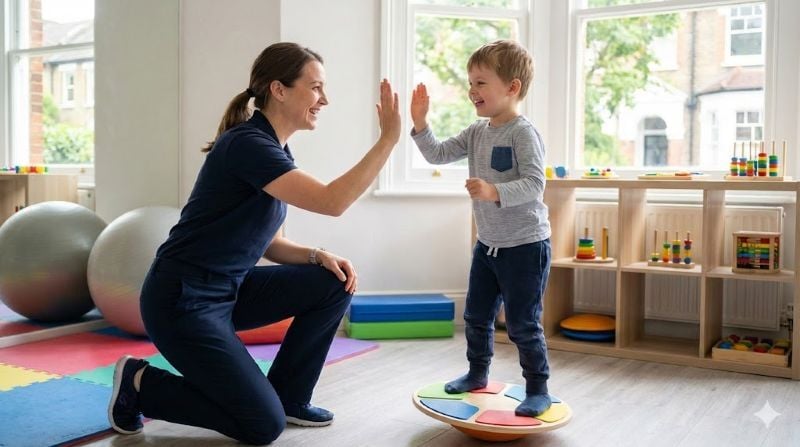
Paediatric physiotherapy—also called children's physiotherapy or pediatric physical therapy—is a specialised branch of physiotherapy focused on the assessment and treatment of babies, children and young people from birth to 19 years. Unlike adult physiotherapy, it requires additional expert knowledge of child development, childhood conditions, and age-appropriate treatment approaches.
Paediatric Physiotherapy in West London: A Parent's Complete Guide
Paediatric physiotherapy is specialist treatment for babies, children and young people from birth to 19 years who have movement difficulties, developmental delays, injuries or physical disabilities. Children's physiotherapists combine expert knowledge of child development with play-based therapy to help your child achieve their physical potential. At CK Physio in West London, we offer appointments typically within days—a significant advantage when NHS community waiting lists have grown by 58% since 2022, with nearly one in four children now waiting over a year for care.
What Is Paediatric Physiotherapy?
The Association of Paediatric Chartered Physiotherapists (APCP) defines paediatric physiotherapy as treatment that recognises the importance of working in partnership with the child, parents and carers to maximise a child's physical abilities and independence.
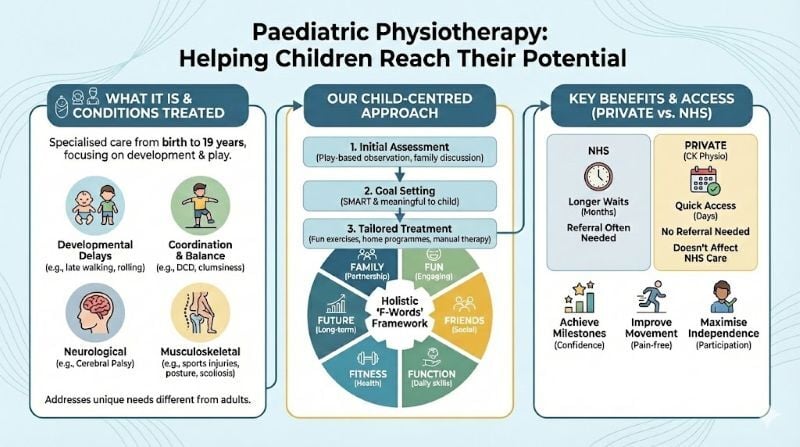 Children's physiotherapists bring specialist skills as physiotherapists combined with expert knowledge of how children develop physically, emotionally and socially. This is crucial because, as the saying goes, "children are not small adults"—they have unique developmental needs that require specialist understanding.
At CK Physio, our approach to children's physiotherapy includes:
- Comprehensive developmental assessments
- Play-based, child-led treatment sessions
- Goal-directed training tailored to your child's needs
- Home exercise programmes for the whole family
- Coordination with schools, nurseries and other healthcare providers
Understanding NHS Waiting Times: The Challenge Facing Families
If you're reading this because you're concerned about your child's development or they've been injured, you may already know that getting NHS physiotherapy can involve a significant wait. The scale of the current situation helps explain why many families are seeking private care.
NHS Community Services: Key Statistics (October 2025)
- 326,000 children on NHS community health waiting lists
- 58% increase in children's waiting lists since October 2022
- Nearly 1 in 4 children wait over a year for community services
- 1 in 15 children wait over two years
- 16 out of 92 providers report over 80% of children waiting more than 18 weeks
Source: Nuffield Trust briefing, October 2025
In West London specifically, NHS trusts typically quote initial paediatric physiotherapy appointments at 3-6 months for routine referrals. The Chartered Society of Physiotherapy has warned that these long waits are causing "irreversible harm" to children, with delays during critical developmental windows potentially affecting outcomes.
This is precisely why we believe prompt access to assessment matters. While the NHS does wonderful work—and we always encourage families to maintain their NHS referrals—private physiotherapy can provide the timely intervention that children often need.
Conditions We Treat
Paediatric physiotherapy addresses a wide range of conditions affecting children's movement, development and physical function. Here are some of the most common reasons families seek our help:
Developmental Concerns (Babies & Toddlers)
Torticollis
Affecting 0.3-2% of newborns, torticollis causes a baby to consistently turn or tilt their head to one side. Early physiotherapy intervention has excellent success rates.
Plagiocephaly (Flat Head Syndrome)
Estimated to affect 20-47% of infants, positional plagiocephaly often responds well to physiotherapy positioning techniques and exercises.
Delayed Milestones
Concerns about rolling, sitting, crawling or walking. We assess whether your baby is following expected patterns and provide support if needed.
Coordination & Movement Difficulties
Developmental Coordination Disorder (DCD/Dyspraxia)
Affecting approximately 5% of school-age children—as common as ADHD—DCD causes difficulties with coordination that impact daily activities, handwriting and sports participation.
Hypermobility
While some degree of hypermobility is very common in children (up to 71%), symptomatic joint hypermobility affects around 22% of children attending physiotherapy.
Balance and Gait Concerns
Including toe walking, in-toeing, flat feet, and general balance difficulties that may be affecting your child's confidence or participation.
Neurological Conditions
Cerebral palsy remains the most common physical disability in childhood, affecting approximately 2 per 1,000 live births in the UK. Physiotherapy is a cornerstone of management, helping to optimise movement, prevent complications and maximise independence. Learn more about our physiotherapy treatments and approaches.
Musculoskeletal Conditions
- Sports injuries in young athletes, including sprains, strains and overuse injuries
- Growth-related conditions such as Osgood-Schlatter disease and Sever's disease
- Scoliosis (affecting 2-3% of children aged 10-16)
- Post-surgical rehabilitation following orthopaedic procedures
- Posture-related problems, including "tech neck" from device use
Our team has experience with sports physiotherapy for young athletes and can help your child return to their activities safely.
Signs Your Child Might Benefit from Physiotherapy
Parents often wonder whether their concerns warrant professional assessment. Here are some signs, organised by age group, that may indicate your child would benefit from a physiotherapy evaluation:
Babies (0-12 months)
- Consistently turning head to one side or difficulty turning both ways
- Flat spot developing on the head
- Seems unusually "floppy" or stiff
- Not rolling by 6 months
- Born prematurely and you have developmental concerns
Toddlers (1-3 years)
- Not walking by 18 months
- Persistent toe walking beyond age 2
- W-sitting (sitting with knees in front, feet out to sides)
- Frequent falls or clumsiness beyond normal toddler tumbles
- Walking with feet turning inward
School-age Children (4-11 years)
- Difficulty learning to ride a bike or catch a ball
- Struggles with handwriting or using scissors
- Avoids PE or playground activities
- Complaints of "growing pains" affecting sleep or activities
- Teacher concerns about coordination or posture
Teenagers (12-18 years)
- Sports injuries affecting training or competition
- Back pain or neck pain
- Visible changes in posture, including potential scoliosis
- Knee or heel pain during growth spurts
- Recovery from injury or surgery
A Note of Reassurance
Many of these signs have innocent explanations, and children develop at different rates. The purpose of physiotherapy assessment isn't to find problems—it's to give you clarity and confidence. Sometimes we'll reassure you that your child is developing normally; other times we'll identify areas where early support can make a real difference. Either way, you'll know where you stand.
What to Expect at Appointments
Many parents worry that physiotherapy will be uncomfortable or frightening for their child. The reality is quite different—paediatric physiotherapy is designed to be engaging, play-based and child-led.
The Initial Assessment
Your child's first appointment will typically last 45-60 minutes and includes:
- Discussion of history and concerns – We'll talk with you about your child's development, medical history, and what you've noticed at home or school.
- Observation of movement and play – While your child plays naturally, we assess how they move, their balance, coordination and motor skills.
- Physical assessment – Gentle examination of strength, flexibility, posture and specific areas of concern.
- Goal setting – Together, we'll identify what matters most to your child and family. These might be practical goals like learning to ride a bike, running faster at school, or sitting comfortably for longer.
- Treatment plan – A clear explanation of what we've found, what we recommend, and how we'll work together.
Ongoing Treatment Sessions
Follow-up sessions are typically 30 minutes and focus on therapeutic exercises, activities and hands-on treatment. Sessions might include:
- Fun, age-appropriate exercises disguised as games
- Balance and coordination activities
- Gentle stretching and strengthening
- Manual therapy techniques where appropriate
- Updates to your home exercise programme
The Importance of Home Programmes
Research shows that children achieve functional goals with approximately 14-25 hours of goal-specific practice—this is only possible when clinic sessions are combined with home exercises. We'll provide clear, practical activities that fit into your family's routine, because we know busy parents need solutions that actually work.
The good news? Home programmes classified as effective by evidence reviews often make the biggest difference when they're simple, achievable and integrated into play rather than feeling like "homework."
Evidence-Based Approaches
At CK Physio, we believe parents deserve to understand the evidence behind their child's treatment. The field of paediatric physiotherapy has evolved significantly, with high-quality research now guiding which approaches work best.
Goal-Directed Training
Modern paediatric physiotherapy is built around goal-directed training (GDT)—working towards specific, meaningful goals that matter to your child and family. This approach uses the ICF-CY framework (International Classification of Functioning for Children and Youth) to consider all factors affecting your child's participation in life.
SMART goals (Specific, Measurable, Achievable, Relevant, Time-bound) are set collaboratively. Rather than abstract clinical targets, these are practical achievements like learning to skip, keeping up with friends at playtime, or managing school bag carrying without pain.
Family-Centred Care
We follow the "F-Words" framework developed by Professor Peter Rosenbaum: Function, Family, Fitness, Fun, Friends, and Future. This means looking beyond isolated physical skills to consider how treatment supports your child's whole life.
Parents are integral partners in assessment, goal-setting and home programme delivery. You know your child best, and your observations guide our treatment decisions.
Evidence-Based Treatment Selection
We follow the best available evidence when selecting treatment approaches. Research has identified which interventions have the strongest support for different conditions—and we're transparent about what the evidence shows.
Approaches with strong evidence include:
- Goal-directed training tailored to your child's priorities
- Strength and fitness training appropriate to age
- Task-specific practice of meaningful activities
- Home programmes with family involvement
- Environmental modifications and activity coaching
NHS Versus Private Physiotherapy: Making the Right Choice
Many parents ask us about the differences between NHS and private paediatric physiotherapy. Both have important roles, and understanding the distinctions can help you make the best decision for your family.
| Factor | NHS | Private (CK Physio) |
|---|---|---|
| Referral required | Yes (GP, health visitor, consultant) | No—self-referral welcome |
| Typical wait time | 3-6 months (varies significantly) | Usually within days |
| Cost | Free at point of use | From £70 initial assessment |
| Session frequency | May be limited by capacity | Scheduled based on clinical need |
| Appointment flexibility | Standard working hours | Early morning, evening & Saturday |
| Home visits | Limited availability | Available when needed |
Important: Private care doesn't affect NHS entitlement
The APCP explicitly states that accessing private physiotherapy should not affect a child's NHS provision. Many families use private care alongside NHS services, or while waiting for NHS appointments to come through. You can keep your place on NHS waiting lists while receiving private treatment.
We're registered with major health insurers including BUPA and AXA PPP, so check whether your policy covers children's physiotherapy. Learn more about our credentials and approach.
Frequently Asked Questions
What does a paediatric physiotherapist do?
A paediatric physiotherapist assesses and treats babies, children and young people from birth to 19 years who have movement difficulties, developmental delays, injuries or physical disabilities. They use play-based exercises, manual therapy and family education to help children achieve their physical potential and reach developmental milestones.
Do I need a GP referral for private paediatric physiotherapy?
No, you do not need a GP referral for private paediatric physiotherapy. You can book directly with CK Physio. NHS physiotherapy typically requires a professional referral from a GP, health visitor or consultant, but private care allows direct self-referral with appointments usually available within days.
How much does private paediatric physiotherapy cost in London?
Private paediatric physiotherapy in London typically costs £85-£150 for an initial assessment lasting 45-60 minutes, and £60-£120 for follow-up sessions of around 30 minutes. CK Physio offers competitive pricing for West London families, with initial assessments from £70.
How long are NHS waiting times for children's physiotherapy?
NHS waiting times for children's physiotherapy vary significantly by area. As of 2025, the Nuffield Trust reported that nearly one in four children wait over a year for community services, with some areas having waits exceeding 18 weeks. West London NHS trusts quote initial paediatric physiotherapy waits of 3-6 months for routine referrals.
What conditions can paediatric physiotherapy treat?
Paediatric physiotherapy treats a wide range of conditions including developmental delays, cerebral palsy, torticollis, plagiocephaly (flat head), hypermobility, coordination difficulties (DCD/dyspraxia), sports injuries, scoliosis, toe walking, and post-surgical rehabilitation. It also addresses concerns about late walking, balance problems and muscle weakness.
When should a baby start walking?
Most babies take their first independent steps between 9 and 15 months, with the average being around 12 months. However, walking any time up to 18 months is considered within the normal range. If your child is not walking by 18 months, or you have concerns about their movement development earlier, it's worth seeking a physiotherapy assessment.
Is toe walking normal in children?
Toe walking is common in children learning to walk and often resolves naturally by age 2-3. However, persistent toe walking beyond age 3, toe walking that appears suddenly, or toe walking combined with other developmental concerns should be assessed by a paediatric physiotherapist to rule out underlying causes and prevent long-term complications.
What happens at a child's first physiotherapy appointment?
At a first paediatric physiotherapy appointment, the physiotherapist will discuss your child's medical history and your concerns, observe how your child moves and plays, assess their strength, flexibility and coordination, and develop a personalised treatment plan. Sessions are play-based and child-led to keep children comfortable and engaged.
Will private physiotherapy affect my child's NHS care?
No, accessing private physiotherapy should not affect your child's NHS provision. The Association of Paediatric Chartered Physiotherapists (APCP) explicitly states that seeking private care does not impact NHS waiting lists or entitlements. Many families use private physiotherapy alongside or while waiting for NHS services.
How long does paediatric physiotherapy take to work?
Results vary depending on the condition and goals. Research suggests children typically achieve functional goals with 14-25 hours of goal-specific practice combining therapy sessions with home exercises. Some improvements may be noticed within weeks, while others take several months of consistent work. Your physiotherapist will set realistic expectations based on your child's individual needs.
Concerned About Your Child's Development?
We're here to help. Book an assessment with our experienced team in Hanwell, West London.
Book Your AppointmentAppointments typically available within days • No GP referral needed
References & Further Reading
- Nuffield Trust (2025). How will waiting times in community health services affect the shift towards neighbourhood health? https://www.nuffieldtrust.org.uk/resource/how-will-waiting-times-in-community-health-services-affect-the-shift-towards-neighbourhood-health
- Association of Paediatric Chartered Physiotherapists (APCP). Paediatric Physiotherapy - Information for Parents. https://apcp.csp.org.uk/content/paediatric-physiotherapy-0
- NHS England (2025). Community Health Services Waiting Lists. https://www.england.nhs.uk/statistics/statistical-work-areas/community-health-services-waiting-lists/
- APCP. Find a Children's Physiotherapist - Private Practice Directory. https://apcp.csp.org.uk/content/find-childrens-physiotherapist
- Health and Care Professions Council (HCPC). Check the Register - Protected Titles. https://www.hcpc-uk.org/check-the-register/
- Chartered Society of Physiotherapy (CSP). What is Physiotherapy? https://www.csp.org.uk/careers-jobs/what-physiotherapy




.svg)

.svg)

.svg)